
Bahar Anooshahr, The Arizona Republic, on Quitting Oral Surgery and Never Eating Free
Bahar Anooshahr, restaurant critic at The Arizona Republic and azcentral.com since May 2026, previously the paper’s dining and nightlife reporter. Beat: restaurant reviews, chef profiles, restaurant histories, farmers markets and cocktail bars across metro Phoenix.
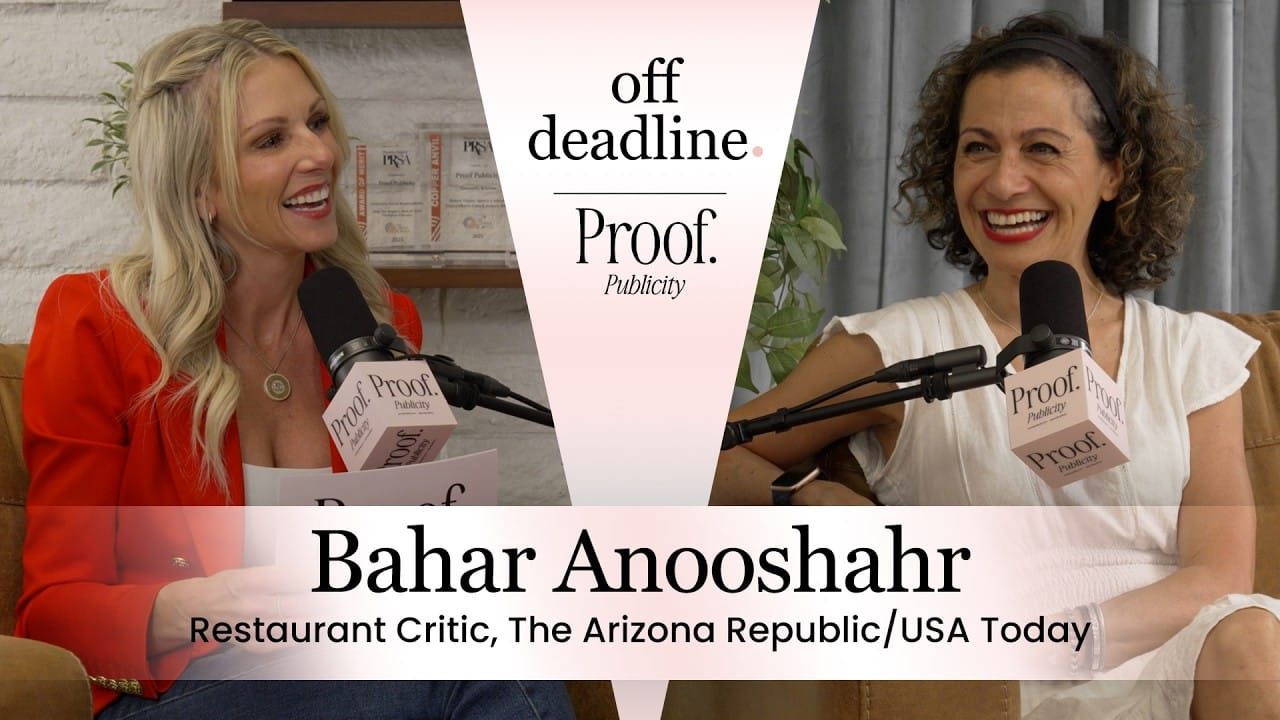
Who is Bahar Anooshahr?
Bahar Anooshahr is the restaurant critic at The Arizona Republic and azcentral.com, a role she moved into in May 2026 after four years as the paper’s dining and nightlife reporter. Born in Iran, Bahar Anooshahr trained and practiced as an oral and maxillofacial surgeon before leaving medicine to write, first for literary magazines on the East Coast, then as a freelance food writer for Phoenix New Times and Eater before an editor’s email brought her to the Republic in 2022. She is a member of Les Dames d’Escoffier, which supports women leaders in food, beverage and hospitality, and her favorite meal is dessert.
In this Off Deadline conversation with Proof Publicity founder Melissa DiGianfilippo, Bahar Anooshahr describes sitting in her car in tears after surgery shifts, the wellness retreat in Tecate, Baja California, where she admitted she did not want to be a surgeon anymore, and the breakup with a partner who shared her love of Michelin-starred dining that pushed her to start writing about food herself. She talks about her parents’ silence and her mother’s later admission that the career change hurt, and about the review of a woman-owned Mexican restaurant that she got right and still gave her nightmares. She also brings her receipt: a new press pass that reads Restaurant Critic, a title she first dreamed about reading Ruth Reichl in a library years ago.
Bahar Anooshahr explains the practical difference between her old job and her new one: a reporter describes what is happening at a restaurant and mostly skipped the places that were not working, while a critic gives opinions, including on TikTok food takes. She talks about her competitive streak, including the day she walked 103,000 steps to beat a Fitbit record, the CRUjiente Tacos closing story she wrote through tears because it was a place she and her late husband loved, and the rule that she pays for every meal she writes about, even when chefs want to take care of her. If she were not writing, she says, she would be a patient advocate. Her advice to her first-year self: no is just a matter of taste, try somebody else.
What Bahar Anooshahr said on Off Deadline
“There was a particular time where I would finish work, and then I was sitting in my car and I’d be in tears and I’m like, I don’t understand because there’s no crying in oral surgery.”
“I know it was the right thing to do, but it was just so, so difficult.”
“It’s it’s from a place of, you know, respect and love for chefs because we want Phoenix to be even better than it is.”
“Whereas as a critic you can actually give opinions.”
“So please understand that if I’m writing about a restaurant, I pay for it.”
“It just means someone didn’t like your story. It’s just a matter of taste. Try somebody else.”
How do you pitch The Arizona Republic’s restaurant critic? Proof’s take
Three things worth taking from this. First, Bahar Anooshahr’s job changed in May 2026. As a dining reporter she mostly wrote about restaurants that were doing well and skipped the ones that were not; as critic she gives her opinion, and she will publish it even when it hurts. If you pitch a restaurant for review, make sure the kitchen is ready, because she goes back a second time before she writes and her editor expects the truth. Second, she does not eat free. She pays for every meal she reviews, turns down gifts and says the number is zero, so comped tastings, gift cards and influencer-style hospitality are the wrong offer for the Republic’s dining desk. Offer access, a chef who can talk, a history worth telling and dates that work. Third, her favorite stories are the ones with a person and a memory at the center, from a pastry chef’s inspiration to what CRUjiente Tacos meant to a widow. Pitch the story behind the restaurant, not the menu. Proof Publicity earns coverage for Arizona restaurants, hotels and hospitality groups with azcentral’s dining team, and this is how we brief clients before we send the pitch.
Watch the full episode
Proof Publicity earns dining and hospitality coverage for Arizona restaurants, hotels and food brands. See our hospitality PR work.
Episode transcript
Read the full transcript
[0:00] There was a particular time where I would finish work, and then I was sitting in my car and I'd be in tears and I'm like, I don't understand because there's no crying in oral surgery. So I'm like, what is this? There was a restaurant, a Mexican restaurant owned by a woman, and I fight for women like I'm all about them. So I went one time, you know, there was some things that wasn't working yet, so I went back again. Similar things happened. And like, my editor is like, well, you have to, you know, you have to tell the truth. I had nightmares about that story for a long time. No, doesn't mean like you're a bad person. Doesn't mean anything like that. It just means someone didn't like your story. It's just a matter of taste. Try somebody else. Don't take no.
[0:38] For two decades, I'd helped brands earn credibility through PR. Now I'm turning the mic on the storytellers themselves. I'm Melissa DiGianfilippo, founder and CEO of Proof Publicity, and this is Off Deadline. The real stories of reporters, hosts and media insiders beyond the byline. Welcome to Off Deadline. I'm Melissa DiGianfilippo, and my guest today is Bahar Anooshahr. Bahar Anooshahr is the Arizona Republic's restaurant critic, covering everything from chef profiles and restaurant histories to farmers markets and cocktail bars, with a particular love for stories that celebrate the diversity of metro Phoenix before joining the Republic. She was a freelance writer whose work appeared in eater, Phoenix, New Times and Unathletic. Before journalism, she was an oral and maxillofacial surgeon. She's a member of La Dame Disco Fire, which supports women leaders in the food and beverage industry. Her favorite meal is dessert. That's mine too. So we were meant to be friends. It's so funny sitting here with, first of all, like, you are such a great restaurant. I'm going to say like reviewer. Critic, you've been reporting on restaurants in the Valley for a while. I've pitched you. You've covered my clients. I am not a foodie. I am really like a kid's menu eater. But dessert? I am a foodie. Yes. So what in the valley today? Is your favorite spot for dessert?
[2:01] Oh, that's a tough one because it just depends on the mood, right? Like, I've gone to bars and have just ordered, like, a drink and desserts. I, I'm going to tell you my one of my favorite pastry chefs is Morgan Malzahn. And so she used to be at Weft & Warp and she left. So she does some events now and whenever I can I'll go.
[2:27] Yeah I'll go. Well, I am so happy to have you here. So much. When I was like, reading your bio, we were chatting before. I'm so intrigued. Okay, so you are. You've been a writer for a long time. Like over a decade, if not longer. But before that, you were an oral surgeon. Okay. How?
[2:44] Okay, so I, I was born in Iran, and, you know, we came here, we immigrated here. So anytime that you immigrate, you know, you have this expectation from the parents that you have to be either for us it was doctor or engineer. I mean, lawyers fine. I think we've gotten to business at this point. Business is kosher too, but I'm not sure. Got it. So yeah. So like I went and I did what I had to do. Right. Yeah.
[3:18] So you started in that space. And then one day you were like, this is not my journey.
[3:22] Yes. So, you know, for a while it basically I would finish work. There was a particular time where I would finish work, and then I would sit in my car and I'd be in tears and I'm like, I don't understand because there's no crying in oral surgery. So I'm like, what is this? So I, I was like, okay, maybe I'm tired and I'm going to just kind of, you know, take a vacation. And at the time, I could go wherever I wanted to because I was a search. So so I went to this, like wellness resort in, in Tecate in, like Baja California. And I did some soul searching there. And that's where sort of the answers came, because I started to ask my like, it's just like doing some nonscientific stuff, which is walking elaborate. And it was like, you know, these questions of what do you want? What do you want? I'm like, what is happening? So finally, this answer came like, I don't want to be an oral surgeon anymore. And I was just like, oh, crud. You know, like, where's this coming from? So it took some time after that, but that's where kind of the seed was planted.
[4:20] It's kind of crazy. That is, I cannot tell you how much I appreciate that story. I think people often feel stuck in a path they've chosen because it's like they think about the chaos it would create to unravel it, and to invest in more education or try something new. I I've always been a firm believer that you're never stuck, that, like, you can always reinvent. I've done some things to reinvent, like when I turned 40, I just like had this epiphany and I think everyone can. So thank you for sharing that. Hopefully it's inspiration for someone. Yes.
[4:49] You know, so it's it's always like if it's your decision, your action, your consequences. So I think it's much easier to face those consequences when it's your decision.
[5:00] Absolutely. So the back story you've given is great. Now let's talk about how you became a journalist. Like why that path? And were you living in Arizona when you started that path?
[5:10] No. So I was in on the East Coast. So like I used to live sort of in the border of New Hampshire, Massachusetts, that area, that's when like when I left oral surgery, that's when I started to do writing. And then I would send my stories to literary magazines and things like that. So that's where the first publications happened. And then and then I moved first to Michigan and then to Arizona. So yeah, so like, you know, I was writing a little bit because I was with someone at the time, so there wasn't really a lot of pressure for me to work. So I was doing some, you know, you know, freelance writing here and there, travel, you no food and stuff like that. And then. Yeah, and then something changed which you were going to ask me about, you know, and then that basically that I'm happy to tell you about it. But it was basically why when their relationship dissolved, that was a relationship where it was really we were both into food. So like we would travel to three Michelin star restaurants, we would do that kind of thing. And so, you know, when the relationship fell apart. I'm like, I want to keep doing this, so how do I do it? And I'm like, what if I start? I want to I want to take myself to these things. And what if I start by writing about them? Wow. That's how it all got started.
[6:28] That's cool. So like a really traumatic or like sad situation and then created this whole career path for you. That is so cool. I mean, and hard probably. But I love that. And then why the Republic? How did that happen? Because it seemed like freelancing was your thing for a long.
[6:42] It was for a long time. So I started to write for Phoenix few times, you know, as a freelancer. And and so I was and I would remember at the time I would kind of, you know, wistfully look at, look at the Republic stories and be like, oh, I totally want to be a part of this, you know, whatever. And I remember that, like it was like three years, I think, after I was at the At New Times that the Republic, I got an email from the editor and it was like, you know, you know, years. Yeah, yeah. Do you want apply to this? And I'm like, I, I don't think I can. And so, so when another one of the Phoenix New Times editors who had left, we had worked together, she also sent it to me. And I was like, all right, I think, I think maybe I need to. Apply. Now it's time to apply. And yeah, it worked out. And I was like, beyond excited.
[7:35] That's so cool. I love that. Let's talk now about like a little bit deeper into the things that you've experienced throughout your career. I want to know what's the piece of your career that you're the most proud of that might not appear on your resume or the About Us page on a website?
[7:51] So I honestly think that, like, the the parts that I'm proud of is being able to leave that previous carrier career, because if I hadn't done that, I wouldn't be here. And I love what I do. So I think probably that and I don't regret going to school for it, because if I hadn't gone and if I didn't have the financial ability to leave, I wouldn't be able to. So I'm so glad that I did it. No regrets, but also looking forward, like I'm so excited that I did. Yeah, yeah.
[8:25] What? I have to ask what your family thought about your decision to make that switch, right?
[8:31] So in the beginning, they didn't say anything. When I make these major decisions in life, I usually have to drop in and feel comfortable enough with myself to then tell them. So I it took me a little while. And then when I would call to tell them they were in Iran at the time, so I called. It wasn't that, hey, you know, I wanted to to give permission, get permission. It was mostly, mostly like I wanted to give you a news, a piece of news. This is what's happened. And there was like silence. And then it was like some years later that my mom was like, you really hurt me when you left oral surgery. And I'm like, sorry. But like, I had to do what I had to do, you know? But dad is always like, that was a courageous thing to do. I wouldn't be able to do that.
[9:14] Wow. See, that's a great, like, probably thing to hear because, yeah, the expectation probably feels pretty heavy on you even no matter the age. Like you could be a full blown adult and it still feels heavy.
[9:25] Absolutely. Absolutely. Yeah. For sure.
[9:27] Tell me about a story that you've done that you got right. But it still feels kind of wrong.
[9:34] Oh, God. Yeah, I have one of those, actually. So there was a restaurant, a Mexican restaurant owned by a woman. And I fight for women like I'm all about them. And so I was super excited to go to this restaurant. And, you know, the Instagram looked really awesome. And I was just like, yes, let's do this. I'm going to write about her. So I went one time and it just there were, you know, there was some things that, you know, he wasn't working yet. So they were not there yet. I'm like, all right, no problem. Like I'm going to go back again. So I went back again. Similar things happened. And I and like my editor is like, well, you have to, you know, you have to tell the truth. And it was I had nightmares about that story for a long time. I know I kept telling myself, like, you are responsible to the readers, you have to tell the truth. So I know it was the right thing to do, but it was just so, so difficult. So difficult. Yeah, it's still every time I look back at it, I just like, oh, why did I even have to do that? Why did I go there like I wish I hadn't?
[10:39] That's so tricky. And if you don't mind, you don't have to say the name of it or anything, but what, did you ever get a response from that business owner about your piece?
[10:48] So the response was mostly when the story was posted to social media. And a lot of times when it's posted not from the dining but from the brand account, you know, they're not going to give you the whole story. They'll give you bits and.
[11:04] They want like the cut line that's going to get all the attention, right?
[11:07] Yeah. So I saw there that that there was like a whole lot of conversation. And she was very sweet because she had read the story and she said, no, no, there was some good things in there, but there were also these other things. And so, yeah, there was nothing mean from her at all. But yeah. So that's a. It's not a good feeling. I know.
[11:26] And that's your job. I mean your job literally is critic. So how do you do that now. How have you taken that feeling and that learning and applied it to like when you go forward, I assume you always hope you can report a pleasant story. But sometimes you probably can't.
[11:41] Correct. So I have I've had to learn to be to be comfortable with discomfort, I have to say. So I have to be able to sit in my discomfort if that's the case or the, you know, whatever. There's a backfiring of opinions or what have you, because it's opinion. So I have to sit in that discomfort and it requires some growing up, honestly, because if you let your little inner, you know. Space brain, you know, run ragged, then it's going to be really tough. So, yeah, no, you have to just take a breath and be like, you keep reminding yourself, you we are here. It's it's from a place of, you know, respect and love for chefs because we want Phoenix to be even better than it is. Continue to get better. So that's where the you know, the goal is that's where it's coming from. So it's not from like a mean place.
[12:41] Yeah. You're not out there trying to like demolish a restaurant. Totally. You're hopeful. I love that you said you want to make Phoenix better overall. And every little piece of feedback you give you, public or not, is going to do that. So and I think people do. They want authenticity and you'll lose your credibility the minute you don't say the truth. 100%. Yeah, I agree., I want to know now, when did your personal life force you to reinvent your professional life? I know we've talked a little bit about.
[13:08] We've talked about it. Yeah. I think basically it was that it's what, you know, it was a in a way the breakup that, that like that dissolving of one relationship that sort of led to this necessity, you know, for work and somehow the that little fire that was like, why don't I just go after the thing that I loved so much? And why don't I just just take it, you know, just kind of it was that I think it was that it's just basically that relationship that was like made me realize I love food. I love experiencing food. Food is like art and I love it and I want to go after it.
[13:49] Were you raised on that? Like were was food a big part of your life growing up?
[13:53] You know, I had forgotten about this, but yes. So my parents have been visiting and visiting me and they cut out are stuck because of what's going on in Iran. And I'm noticing in apparently in our culture, everything can be fixed with food. If I have a headache, my mom's like, you haven't eaten. Probably if something else is going on, my dad's like, did you drink water? Did you eat this food? You have to have this other kind of food then. And you know, so it's all about food. So probably. Yes. And food was important in a sense that like, we all came together, you0ven throughout the war, like, I remember we would come together a family. It's like a bowl of nuts and like bowl of fruits. And there's that always. There's something. Yeah. You know, funerals, there is a particular food for funerals. So yes I would say yes.
[14:41] I like that. Like it's also the bringing people together no matter the situation. And that's when you go out now to restaurants that you're reviewing let's say is it a community thing for you or are you bringing a friend? Is it a self like experience? It's really personal to you. What is that like?
[14:56] Depends. Like there are times that most of the time I'm going with someone. There have been times where I just want to focus, you know, really deeply on, on all the elements and then that in that sense, then I'll go on myself.
[15:09] Yeah. That's nice. It's nice that you get to like, go do that for a living. What a dream. Someone others like, how do I get this shot? You know? Right. What's the thing about you that your audience would be the most surprised to learn?
[15:25] I don't know if it's like this is going to be kind of a silly thing, but I do get, I get I tend to get kind of competitive still, even though, like, I feel like I left surgery, so I left the competitiveness. But I don't think I fully have. So and I love to exercise and I set challenges for myself. So one day I looked up, I used to have my Fitbit, and then I looked up and saw that like someone had walked, the maximum number of steps per day was like 100,000. So I decided to beat them, and I walked 103,000 steps that day just to beat that person. Wow.
[16:01] So you're a little competitive. Just like a touch a little bit. Yeah. And that is so I still can't get over this right brain. Left brain. Like being a surgeon, being a writer. Two totally different careers. And you bring competitiveness into that. Like it's just such an interesting mixture of characteristics. Yeah, it's really cool. I bet you could do a lot of careers and be successful with that mixture. That's helpful to hear. I have no idea. But it's just like it's just a thing. It's the thing. Yeah. Okay. Ask you to bring a receipt like something that has a story attached to it. What do you have for us?
[16:33] Oh my gosh. Okay. All right. So I brought you a and I brought you my press pass. But then it doesn't say these words on it. Here's what I have. And it's basically it says my name. And underneath it it says my new title Restaurant Critic. And I have to tell you about it because. So all those years ago when I left my career, I remember, you know, hanging out in libraries a lot and reading a lot, and I came upon a book by Ruth Reichl. And then and so she was the restaurant critic of The New York Times and then the editor of gourmet. And I remember reading her book and just being mesmerized by her voice, by her style, by her job. And, and I at the time, I wouldn't dare even dream about a position like that. You know, it took a long time for me to say, I want this, right? But like to finally get here. It's just this circle for full circle and it made it all worthwhile. I'm so, so, so proud of it. I'm so excited about it. Yeah, I just I love it.
[17:41] So when you got that promotion because that was recent, I remember it was announced is what was your title before again.
[17:47] So I was like a it was I was dining and nightlife reporter.
[17:50] Yes. Okay. And what can you just describe for those who don't know, like what is the difference in those two jobs?
[17:54] Sure. So as a reporter you're focusing on what is mostly and it's the you know, you're you're you're describing what's going on with a place you're not really giving opinion. Whereas as a critic you can actually give opinions. So if you looked at my previous things, most of them 99% of the time, if I went to a restaurant and I, you know, it didn't work out or wasn't good, I would not write about it. I would write about the restaurants that were doing well and then but now I can say all the things. And also if there is something, someone who has an opinion on TikTok, for example, we just had a story where someone talked about a restaurant on TikTok but had a very interesting approach and bizarre. And so that was something where I, you know, I wrote my opinion about it. So it's kind of that.
[18:56] Yeah. So it's like the pop culture of restaurants, almost like what is like the experience, but also like what are other people thinking and what is my personal opinion. Right. That's interesting. And do you have more now requirements on social media with this job? Like are you going to start adapting more to TikTok or Instagram for that.
[19:11] So hopefully Instagram. Yes, it's funny because I constantly video places whether we're doing, you know, on the scene with photographers or, or behind the scenes or what have you. So I usually do that and I have a ton of stuff. But, you know, again, there's like this little perfectionist in me that's like, does this look 100% right? If it doesn't, I'm not putting it. So then, like, I have a ton of stuff and then Instagram is quiet.
[19:33] Yeah, it's so hard. It is hard.
[19:39] To get out of your own head. I found for me, like I used to over edit overproduce like really cared about every moment. And then I realized, like, really, people don't care. They're not watching as much as you are. And also just getting content out that, you know, is 85% perfect is like all you need to do. You know, it's so hard though when you're perfectionist.
[20:02] We're in rapid fire. So your job is to answer like the first thing that comes to your mind and then tell a little story. Okay. The comment section moment that lives rent free in your head.
[20:12] Oh, God. So that actually does have something to do with this new TikTok thing that okay, okay. Yeah, but it was something like someone said this, I mean, it doesn't anymore, but it did for a while. Something about like, this story is deplorable. And I was like, oh dang.
[20:27] Like big word for a person who probably didn't read the whole thing.
[20:31] Exactly. That was a problem because it's like I, you know, looked at the cards and I'm like, you didn't read this or you looked at the Instagram cards.
[20:37] Yep. See, that always happens. Best headline, lead caption or post you ever wrote or wished you wrote?
[20:44] Post as in story? I would look at it that way. So okay, so the best story I would say is when CRUjiente Tacos closed. And such a beloved place.
[20:58] Yes, exactly. And that was a place that I'm going to make this heavy. Now get ready. Okay, so that was a place that my late husband and I used to go all the time. And so when that place. So, you know, when you lose someone, you are sort of like you're holding on to some things that still, you know, brings them back to you. And so when you lose a place like that, then it's like I just lost a piece of him in a way. And so it just it was so hard. And I don't know, I don't know how I wrote that because it was through tears and it kind of like just flew through me. And I don't know, I don't know, it was quick, it was easy and it was painful and it worked out. And I got like so many beautiful responses from the readers. I just it's one of my favorite things.
[21:55] Oh, I'm so happy that you got to cover that. But also, I'm so sorry about your husband. Thank you. And I can can't relate exactly. But I understand the feeling of like, wanting to hold on to a memory. And if a place closes, it's like gone forever. And that's tough. Well, what's the unwritten rule of your industry that nobody will say out loud?
[22:17] So something that people may not know, I guess it is that we do not take free stuff. Yes. So so please understand that if I'm writing about a restaurant, I pay for it. There are. And I love their hospitality. I love when chefs, you know, when I'm not on the clock and they want to take care of me. I love them so much. But even that, like. We're not supposed to. Make it, you know, like, I'll figure out a way to, like, you know, it's going to even out in the end. It. I'll figure a way. So I'll pay.
[22:48] For it. Yeah. So it's basically that.
[22:51] Yeah, I think a lot of people don't realize that there are any legitimate media outlet. Right. Most, like the Republic, is a good one. You follow journalistic standards even though you're writing opinion right now. Yes. Yes. You're not allowed to accept gifts, I think over like 25 bucks or something like that, right?
[23:04] Zero zero. But the most part, zero gifts. So yeah.
[23:07] Yeah. Interesting. Yeah. And I think people don't know that for sure. If you weren't doing this. What would you actually be doing right now?
[23:14] Okay. Torn between two things. So I would either do I would still write. So I would I would still be writing, I would freelance. Right. But if writing is like totally, you know, off the table, then I would say I would be a patient advocate. It is so important to me, like, you know, as I dealt with my husband's illness and all that stuff, I really feel like you have to be on. You have to pay attention. You have to really. You can't just take whatever is given to you. You need to advocate for your patients.
[23:46] That's that's really great. I had Stephanie Ineson here. She was when I first interviews this season. She's the health care reporter for the public.
[23:53] You know, I. Love her.
[23:53] And she talked a little bit about just that a little bit too. And I think, gosh, our system here is so interesting. And I think navigating it is so challenging. Yes, yes. Okay. Now last question. What's the piece of advice you'd give your first year self? The honest version, not the LinkedIn version.
[24:11] I would say don't take no for an answer, because I feel like I don't know if this is gender related or I mean, you have to understand, I grew up in Iran, so there's that. I don't know what it's it's related to what or maybe just personality. But I feel like we need to sort of like, you know, it's okay. No, doesn't mean like you're a bad person doesn't mean anything like that. It just means someone didn't like your story. It's just a matter of taste. Try somebody else. Like don't don't take. No. That's what I would say.
[24:42] That's a great piece of advice. And I wish I would have learned that earlier in my career too. But I think like if young people can learn that now, and I think the feeling that you get internally as women mostly, I don't think I'm assuming that most men don't take this as personally. But you do. You take that rejection so personally, it could be anything but the things that I've been rejected on or failed on in my career have like taught me and gotten me so much further. So it's like I can look back now and be grateful. But in the moment it's heartbreak.
[25:14] Yes, I think that's where you have to, like, learn to stand on your two feet in the middle of the discomfort, take a breath and just be like, I'm here. It's okay. I'm safe. It's okay. Like there. No, doesn't mean I'm out in the, you know, jungle and like, some sabertooth tiger is going to come get me because that's the fear, right? Like, no, you're not you're not thrown out, you know, you're you're just it's just one person.
[25:44] This has been such a pleasure to get to know you. Can you tell everyone where to find you online?
[25:48] Yes. I think the best place is, aside from azcentral, I think the best place is my Instagram, which is at Bahar Creative. That would be the best.
[25:48] Yeah, perfect. Well, we look forward to reading all your new stories as restaurant critic. Congratulations again and thanks for.
[26:05] Being with you so much, I appreciate it.