
Brad Perry, Arizona Daily Mix, on 35 Years of Morning TV
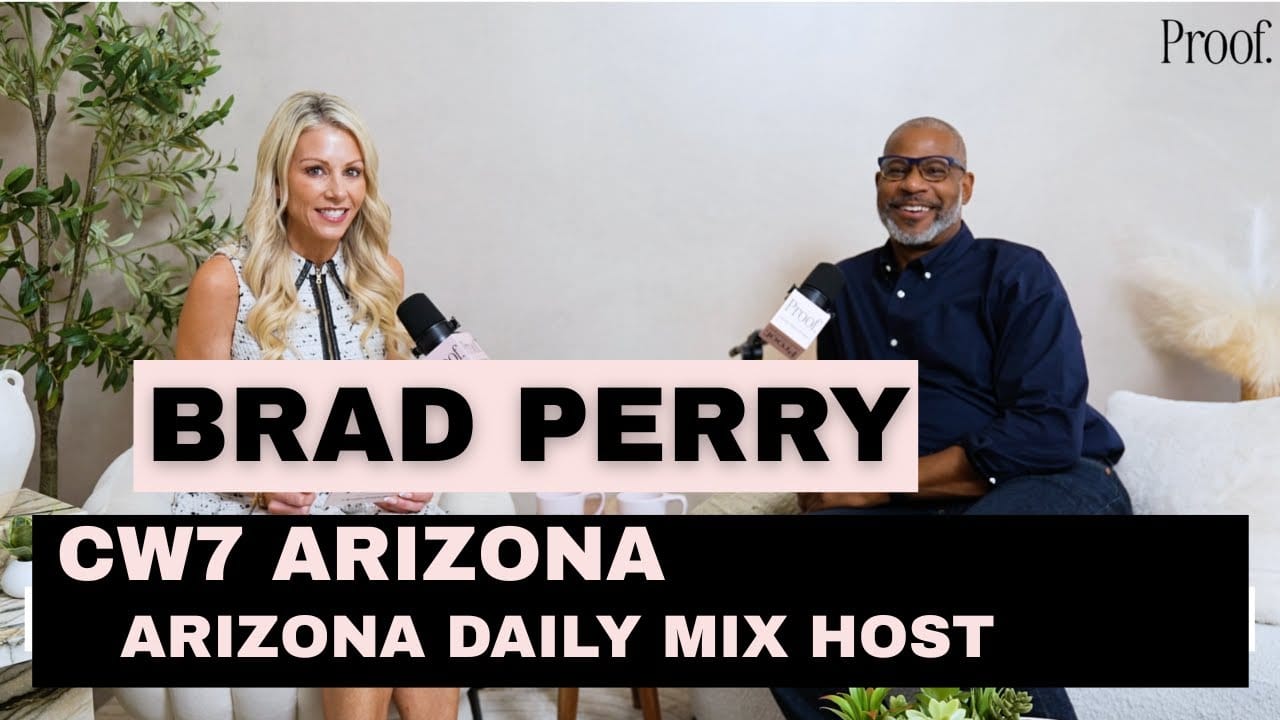
Brad Perry, host of Arizona Daily Mix on AZTV and CW7 Arizona, a former Good Morning Arizona and Good Morning San Diego personality with 35 years in morning television and entertainment.
Who is Brad Perry?
Brad Perry has spent 35 years in morning television and entertainment. He trained in standup and at Second City in Chicago, worked as a production assistant and warm-up act on the Jenny Jones Show, doubled Damon Wayans in the film Mo’ Money, and was working at the Gap the day an agent called with a weatherman job in Phoenix, a city and a subject he knew nothing about. He spent nine years on Good Morning Arizona, more than seven hosting on KUSI and Good Morning San Diego, created the acoustic music web show Untapped Unplugged, and now hosts Arizona Daily Mix on AZTV and CW7 Arizona.
In this Off Deadline conversation with Proof Publicity founder Melissa DiGianfilippo, Brad Perry traces the path from wanting to be an actor to becoming the funny weatherman, and the day in San Diego when a hostage situation forced him to report a hard story hours after a SeaWorld segment. He talks about taking criticism personally in a business built on being liked, what his old news director taught him about the one viewer who complains, and why he now watches view counts instead of follower counts. The center of the episode is the morning at Lake Havasu when a woman waited two years to hand him an envelope: the suicide note she had been writing when his dance on Good Morning Arizona made her laugh.
Brad Perry also talks about the stories that stay with him, especially the homeless teenagers he met covering San Diego, and why he still tells his own kids they will always have a roof over their heads. His proudest achievement outside the resume is those kids: a daughter who is a comedian and actress and a son who writes and directs. He credits meditation, cold plunging and being kinder to himself for the way he shows up on air as an introvert. His superpower is reading a room, his dream interview is Denzel Washington, and his advice for new journalists is to be patient and not take yourself seriously.
What Brad Perry said on Off Deadline
“I’ve been waiting two years to see you because I want you to rip this up with me.”
“While we do something in this business that changed people’s lives, no matter if it’s good or bad, we are changing people’s lives. And we have to realize that.”
“I didn’t take myself seriously. I think that was the key thing. So I wasn’t looking for me to be perfect at it”
“Brad, that one person that complain means there are 100 people who didn’t.”
“Meditation. Patience. Cold, plunging, being good to myself and then trying to be better to other people.”
“I can read a room. I can read the room.”
How do you pitch Arizona Daily Mix? Proof’s take
Three things worth taking from this. First, Brad Perry is an entertainer first and a host second, and he says the moment he stopped trying to be perfect he got better at everything, including hard news. Arizona Daily Mix is a lifestyle show, so pitch the segment that plays on air: a demo, a tasting, a personality, something he can do rather than something he has to read. Second, he measures himself by whether he made someone’s morning better, and the suicide note story is why. A pitch that gives him a real person and a real moment, not a press release, fits the way he thinks about the job. Third, he pays attention to reach over vanity metrics and has heard every complaint in the book, so clients who show up prepared, on time and relaxed on camera are the ones the show books again. Proof Publicity places Arizona restaurant, hotel, retail and lifestyle clients on Phoenix morning shows, and Arizona Daily Mix is one of the places we take them.
Watch the full episode
Proof Publicity earns morning show segments for Arizona hospitality, food and lifestyle clients. See our hospitality PR work.
Episode transcript
Read the full transcript
[0:00] To be. Welcome to Off Deadline. I'm Melissa DiGianfilippo, and I am so excited about my guest today. He is a long time friend and a serious journalist. Brad Perry Brad Perry has 35 years of experience in morning television and entertainment. His on screen career began after attending Holy Cross Junior College at Notre Dame, when he relocated to Chicago to study, standup and train at Second City. He started as the man about town on Morning show and then joined AC families Good Morning Arizona for nine years before hosting KUSI and Good Morning San Diego for over seven years. He also developed and hosted Untapped Unplugged, a web show showcasing acoustic artists that he took to television with a special in Jamaica. Today, he hosts CW seven, airs on a Daily Mix and is a proud father of two. And if you know him, you love him. Thanks for being here.
[1:12] Thank you. Wow. I can't believe you got all of that. That's all chipped away or whatever.
[1:12] No, but I really appreciate you being here.
[1:12] No, this is great. Listen, I'm. I'm pretty much, like, honored because I'm talking with this lady who is just a, how can I say a firecracker in the world of PR, but also just throughout the valley? Yeah. You're amazing. Mom, and you're just an amazing person, so I so I got to come in. I got to show what proof is all about.
[1:34] Thank you. Well, I love working with you. Anytime we get a chance, you know, to get you out to a client or do a video segment with you, you make it fun. You make it easy for clients and fun for people to watch. And I think that's what I want to show people today is like, who's the guy behind the camera? You know?
[1:47] So I'm just this boring guy. Yeah. You know, just sits in my room and plays, you know, connect for, false.
[1:47] Okay. Actually, I first remember meeting you.
[2:05] You don't remember that? Probably remember studio 360, the spin studio?
[2:05] Yeah. So, like, I was a total junkie there when I first started my first company, like, in 2008.
[2:05] And you were there all the time?
[2:05] Yes. I loved doing it. And all them I was there, I was I was like, that was when I was on my fitness journey. But also just like working out.
[2:21] Yeah. And I found a place that was just like home and fun. That was really great. I mean, that was just a blast there. And then, I thought I was cool enough to move up to the front. Never do that again.
[2:21] I did the front.
[2:21] Yeah, but I'm an overachiever.
[2:21] Yeah, but you were. You were. You're like a front kind of person.
[2:36] Yeah. Mine is where, you know, it's kind of sad when they tap you and go, excuse me. You need that. You're off beat. Yes, sir. And move to the back. So that was it.
[2:36] Wow. We've met. That was a while ago.
[2:50] That was a while ago, so.
[2:50] Oh, my goodness, it's been a minute. Yeah. So I want to start with your backstory. I know we read a little bit about it, but why did you choose journalism.
[2:50] So my original goal was to be an actor. So that's why studying wanted to do comedy and stuff. And then to somehow it, it morphed into, landed a job at the Jenny Jones Show being Jenny Jones.
[3:12] I haven't heard that name in a hot minute.
[3:12] Yeah. So I was a warrant person there as a production assistant. I was really working behind the scenes a lot. Yeah, on movies and stuff. My first real job was doubling Damon Wayans with the Wayans family. On Mo Money. And then somehow at the warm up, time of Jenny Jones show, someone from WGN was there.
[3:35] And was it WGN first, or do we know somebody from
[3:35] saw me first and they was a PBS type station and staff, asked me to come do while Chicago. Okay. Which is around the town. Kind of crazy thing we did. And then that led me into sending a tape over WGN again. Someone saw me and said, hey, do you want to come fill in for a while? And so I did. It was actually supposed to be just for like two weeks, and it turned into like three months. And so I was hopefully going to get hired on WGN, but one, I didn't have a degree. And two, that and usually don't hire anybody, like, unless they have at least a good two years experience. I mean, you're looking at I mean, that's a huge station marketing stuff. And so I somehow landed an agent, and next thing I know, my agent's like, you know, what do you know about the weather? I go, nothing. She goes, well, what do you know about, you know, Arizona? I go, it's hot. It's like there's a weathermen strike because we were trying to get me on TV more, too, because I've written one of my own talk show. And so that's how it kind of, like, chose me. And so next thing I know, I'm the weatherman in Phoenix, Arizona. Yeah. I had no degree, no nothing. I literally, the day I got the job, I was working at the gap. I was finishing up my shift, folding up, and I got the call. And said, hey, do you want to come work in Arizona?
[4:57] I'm like, I'm out. So I went, and I hate to say it, but I'm guessing that the gap paid more than your first job in TV.
[4:57] Oh, yeah. Oh, yeah. It's it pays more than that, too. So it did. It actually kind of like did. But, but that's the way you do it. That's the way you do it. Yeah. It's a love of the business. I mean, if I didn't have any bills to pay, I would do this for free. Don't tell my bosses that. Don't say, cut that part out.
[5:13] You got it right. Okay, so we're going to go deep today. Okay? We're going deep. Which story that you've covered or worked on has pushed you the furthest out of your comfort zone. And how did that experience transform you as a human and as a reporter?
[5:32] Josh. I think it's going to be a couple different ones. I think, when I've had to go on serious stories, because I've always been the funny guy, the funny weatherman. So when I was working in San Diego, there was breaking story, there's a hostage situation, and they sent me out because I was only like team person out there at the time. And so I had to go out and it really changed my persona of having to be serious. And really take, take news and stuff. Seriously. So that was that was really a big one that really kind of like did it for me.
[5:57] Yeah. And was that like that transition. Were you prepared for that? Was it really hard to step into that?
[6:14] I was prepared because one, I didn't take myself seriously. I think that was the key thing. So I wasn't looking for me to be perfect at it and, you know, not to make any mistakes. I mean, I knew I was going to I wasn't my forte. But it made me do a little more deep research of what was going on, listen to what's happening and stuff, and do some reporting that way. Yeah, but, I think it's still it was still part of my community, kind of, persona because I was reporting on what was happen in the community. I just had to change my, type of reporting.
[6:34] Yeah. You know, and maybe not so much comedy in that moment, right? Like, I imagine being, like, comedic can help lighten a really hard situation.
[6:54] But there's also, like, a time and place. And the funny thing was, I was I was covering, SeaWorld at the time. So I'm like, at SeaWorld with the dolphins, all workers. And I was like, okay, we're sending you to a hostage situation. This right on the other side of the bay. And I was like, okay, wow. So yeah, big change and big change. So that was one.
[7:10] Okay. Can you describe a time when external pressures created a professional dilemma for you on the job? When you meet external, it could be politics. It could be the, you know, family dynamic. Maybe like a change in your life. Anything. What changed? Yeah. Like what? What happened in your life that might have created a dilemma for you in your job?
[7:38] Oh, gosh. Where should I start? Me. Myself. And I, I'm just trying. I think probably me. Yeah, I probably me. Me being hard on myself, wanting to be professional. I think also worry about what people think, what people are saying and stuff. Yeah. Outside world did it. Yeah. To me a little bit. I think it really it showed I'd say probably I probably around 911, I think when 911 happened and everybody really went to judging people and were scared and stuff, I think that really started to really change my, my being and my focus a little bit.
[8:17] Yeah. That's it. Yeah. And I also you said something about, you know, what people think and yeah. And you're on the news every day and people are judging you left and right. And now with social media, it's like a whole nother layer, right. How do you prepare for that and how did you get through that. Like feeling
[8:17] I haven't I haven't yet. And that's, that's the problem we have as people who are, we can say the entertainment world because that's what we all are. We're entertainers. No, we we take things personally when we don't need to, and we fill things more. I think that's the that's the big part. I think with me, I feel a lot more. And people don't think you're supposed to. Yeah. I'm not supposed to. I'm a guy. I'm a big guy. You know, you're in this journalism part, but it's not supposed to feel anything. If you really pay attention to some of the older news people, they were very hard. I mean, you probably had somebody to talk to and you would, you know, try to get them to even lighten up a little bit. And you probably have something that just really are just, no, I'm not supposed to. My feelings are not supposed to my opinion or anything. And with social media now, I think it's it's even harder because we want to have fun. There's a lighter side to us, but, you know, we still have to keep that window. Yeah. And like any feedback, especially negative feedback, can sit so long with you when like you wish it would just roll right off.
[9:31] But I just can't imagine your job. You hear all the things good and bad.
[9:31] Yeah we do. It's kind of funny that, my, old news director, Philip Dress, who was amazing, he would always say to me, he goes, Brad, that one person that complain means there are 100 people who didn't. And it's because the person who's complaining is just wants to be heard. You're the loudest, the loudest are in like that. And that might not mean anything. But guess what? There's a hundred out there that love you. They don't need to call them and make a complaint. Yeah. And then he said, you know what? That one person will like you tomorrow. That's the thing about it. I, you know, it's where I write about you. It's about them. Yeah. And so it's where I could do something that they didn't like today. And then tomorrow they're like, oh my god, he's so funny. And that that's a lot of things. And then when it comes to social media, I think we have the problem is, is that we want that instant gratification and we want to, you know, we want to go viral. We want that viral. We want those likes and stuff. And so this is what I've learned. And maybe as PR we we start to see it too, is that it's not so much your followers, it's how many views you get and how many people see things. And that's more important to me now. Yeah, because I might have, you know, I only have maybe like, I think I have three followers. Not. Okay. But yeah. So I might have that many followers, but then I have a lot of views on my stuff. And so I think that's really helping to adjust and our world, because we really don't see numbers when we're doing numbers now for our ratings. So it's a it's a big thing. Yeah.
[10:38] Thank you for sharing that. So was there a time when your work created a really positive change that maybe exceeded your wildest expectations?
[10:55] Oh yes. Okay. I love telling the story. We got time. Oh you hit it. So anyways, I was a little bullet notes. Skinny. So this one I always like to tell is like, I didn't realize my gift until this happened. We used to do this around, Arizona thing from an Arizona thing. On. Good morning, Arizona. And we're up at Lake Havasu, one morning, and I'm up there and I have one of my photographer with me, and we're getting ready to do the show and everything, and I'm in the trailer just putting together some stuff, and they always joke about people coming up, fans and stuff. And so they come to me like, hey, this lady wants to see you. She's a big fan. Brad hahaha. Joking around, I'm like, yeah, okay. I come out and I see her and she stand there with an envelope in her hand and she says, I've been waiting two years to see you because I want you to rip this up with me. And I was like, what is it? She goes, this was my suicide note. I was sitting at my kitchen table writing this suicide note. You came on TV and you did your crazy dance and you made me laugh. I just got goosebumps and I and that. And that just meant a lot to me. That I knew I had a gift there and that was it right there. So that's something that showed that what I do is important. But yeah, so we sat there and ripped up her suicide letter together.
[12:14] Like, what is that feeling like, knowing you probably never imagined you'd have that kind of impact on someone, right?
[12:40] Yeah. No. It was. That's when I really knew, like, oh my goodness. While we do something in this business that changed people's lives, no matter if it's good or bad, we are changing people's lives. And we have to realize that. But most of the time we're changing for the good. Yeah. And even though we're going on a bad story or something like that, or we have to interview that mother who's lost somebody or something like that, we are actually doing good. But that's where I look at myself of having fun out there and doing it and makes someone,
[12:40] yeah, that's awesome. Thank you for sharing that story. Was there an instance, you know, where you maybe witnessed something that was really hard to process emotionally on a story? Oh, gosh. And you shared a couple of things earlier, but like maybe there's something that really sticks.
[13:13] You know, the toughest one is, probably when we work with the homeless. Yeah. And we have. That's a major challenge in Phoenix. Yeah. Major challenges face anywhere. But I think the it's where you're staying there. You're trying to be light in everything like that, and then that mother or child step up and you and you kind of look at them, you're like, how are they homeless? How are they been abused and anything like that. And I think that's one that's always gets me. And you hear their story, that people don't realize. And, you know, and especially when it comes to the kids and, you know, when I worked in San Diego and I don't know if they have them here, we call them backpack kids. And what they are is that those are kids that you might see walking around the mall at 230, 3:00. You might see them at 7:00 at night, 8:00 at night with the backpack and stuff. And that's because they're homeless and all their stuff is in that backpack. And I didn't know that until someone explain it to me. That's a backpack, kid. They can tell because they're just wandering around and kind of looking and you think, oh, they're school, or they just it out and stuff. And so that's the one that really gets me to is that I can now see a backpack kid and that's that's changed my life to see how we need to help the homeless and how, I mean, kids.
[14:25] Yeah. And like, as a parent, too, I imagine like seeing that. And you probably had young kids at that time if you did it and like, you can't unsee like how up someone could let their kid be that way.
[14:47] Yeah. Right. Yeah. And how they, you know, have nowhere to go. And that's why I always, I always tell my kids, you know, even as they're older now, you'll always have a roof over your head. You'll always have, you know, you always have a place to come home. Yeah. No matter what. Go off. If I don't talk to you for a month, you always have a place to come home.
[15:04] Oh, that's. That's a good dad. Well, that's. I mean, I think every parent should just say that to their child, even if they don't mean it like that. Seriously. And it helps them grow. Because there's days we want our kids out of the house. Yeah. But anyway, so. Yeah. But. Yeah. Yeah. So. Well that's tough. I, I bet you've seen also things that you just never want to talk about. So again as well. Yeah. What professional accomplishment are you the most proud of that doesn't appear in your bio or on your resume?
[15:21] Well, I well, it kind of like doesn't. It's my kids. Yeah. I mean, it's my kids. And seeing them thrive and what they love do it. And in the business, my kids are also in the entertainment business. So. Yeah,
[15:40] tell me what they do.
[15:40] So my daughter is a comedian and an actress. Okay. She was on HBO Max's South Side, and she does stand up and stuff. Now she's writing memes and making tons of money. Isn't that crazy? I know, I'm like, what do you do? I don't know, writing memes. So for The Real Housewives of Politics and so she goes and talks to all the it's like crazy. It's it's awesome. And she and she just does all the way. Then my son's a writer director and so and he's working on his career and stuff for the last 11 years he's been good. But no, those are the concerns. And I think what it is, the accomplishments, are pretty much able to still have a a face in the Valley. I think it's kind of neat that I still have, you know, grandparents and parents and the grandkids when they show the old videos to and stuff like, oh my goodness, we watch them in the morning and stuff. It's kind of neat. Yeah. That's good. Yeah it is. The only thing I don't like is that when someone walks, you know, a woman comes up and her husband or anything like that. Oh my God. Sweet. It's the guy used to wake up in the morning with him. It just turns into a big fight. I'm like, no no no no no no not like that. So that's I imagine that happens.
[16:47] What aspect of your personal background shapes your reporting in ways that the audience might never recognize?
[16:47] Meditation. Patience. Cold, plunging, being good to myself and then trying to be better to other people. Yeah. Try not to be so angry at myself. That's the thing. It's so easy to be so hard on yourself. And also, too, I'm a big introvert. Do not realize that I'm still a big introvert. So I have to really, like, work on.
[17:16] I never have guessed that.
[17:16] No, no, probably like the downtime was probably like that recovery is is why that's like the most impactful thing. Yeah. The meditation you know and just kind of like working out doing things. So yeah you know so on fitness all that does it. All of them, all of it.
[17:33] That's your current favorite workout?
[17:33] That's that's my favorite. That's not my current one. Yeah. This is my favorite one
[17:33] I love to hear that. Okay. We're going to go into some rapid fire.
[17:33] Oh, rapid fire questions. Hold on. Let me just make sure you're ready. By the way, I love my proof. So some good stuff up in here. Oh my goodness. What we got. So that's why she said drink something before we do the red flies. That's what I'm on loopy. Let's do it. All right okay. First thing that comes to your mind is what you have to go with. Oh my goodness. Yeah okay. You okay.
[18:06] Well, there's one interview subject you're secretly hoping to land
[18:06] Denzel Washington. Ooh, that is so cool. If you get him, can I get him to, like, somehow, I don't know, tell, like, talk to him? Yes. Come on. Okay, okay, I love I love the sleeves. Just blushing. I love this because she's such a that's like God.
[18:28] Okay. Your secret journalistic superpower.
[18:28] I can read a room. I can read the room.
[18:28] Yeah. Story you cover. If your editor said unlimited budget go wild.
[18:28] Oh, the story will probably be, I mean the Oscars. The Oscars or the Emmys. Yeah. Those will be my biggest win. If I can do a whole big production show on that, I would just interview all the celebrities, everybody and stuff. Yeah, that'd be really fun.
[18:58] Yeah. What would you wear?
[18:58] Oh my goodness. Where will I be wearing? You have to know that stuff, right?
[18:58] I know, well, that's hard for guys.
[18:58] I just, I guess I'd just wear some some shorts and, you know, I dress as Adam Sandler. Yeah, yeah, I know. Right? He shows up soon. Nothing like he cares.
[19:16] So what's the weirdest thing you've ever expensed for the job?
[19:16] The weirdest thing I've ever expense for the job. Oh, my gosh. Had to thought that there's been a lot of stuff.
[19:16] You gotta give me one.
[19:33] Probably. Oh, gosh. And this is a rapid fire one. I'm gonna. I'm gonna say an adult toy. Yeah, for the job. Yeah, sure. Yeah, that was for the job.
[19:33] What's one piece of advice you'd give to someone just starting in journalism today? I just want advice.
[19:33] Yeah. Don't take yourself seriously. And I'm sorry I have to get more, but that's okay. Be patient. And, And just love yourself,
[20:05] I love that. That's great. Thank you. Brad. Is there anything else you want people to know about you?
[20:05] I'm trying to think. No, I'm just enjoying life. I'm enjoying life. And. And one other people do enjoy life and just try to keep people smiling, I guess. I mean, I said I was an introvert a little bit, but yeah, that's nothing. I mean, not like major major, but. So I go home to relax or anything. Yeah. But I think also one of them too, is that I think this young lady right here is amazing. Melissa, prove beyond being this incredible. Can I say that?
[20:27] You can say that.
[20:27] There you go. Yeah. I'm not gonna stab you. There you go. No. That's it. No. Thank you. Thanks for having me. This is awesome, cause I'm so excited.