
Corina Vanek, The Arizona Republic, on Breaking the TSMC Story
Corina Vanek, development reporter at The Arizona Republic and azcentral.com. Beat: real estate development, zoning and business across metro Phoenix.
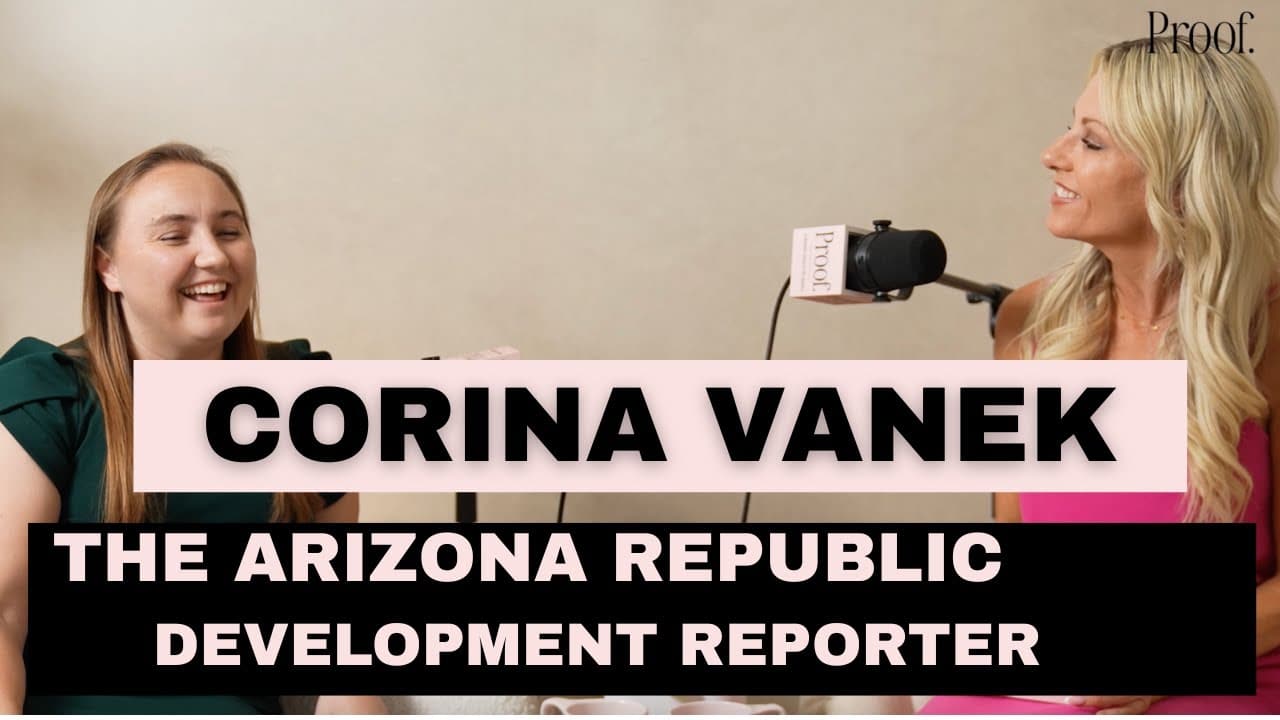
Who is Corina Vanek?
Corina Vanek covers development for The Arizona Republic and azcentral.com. A Phoenix native and Ironwood High School yearbook editor, Corina Vanek graduated from the Walter Cronkite School of Journalism at Arizona State University, interned at the Republic, started her career on breaking news at the Arizona Daily Sun in Flagstaff and covered commercial real estate for the Phoenix Business Journal before joining the Republic.
In this Off Deadline conversation with Proof Publicity founder Melissa DiGianfilippo, Corina Vanek explains how she found the story that defined her career. Reading public documents at the Business Journal, she spotted a huge land rezoning in North Phoenix, watched the story pull unusual traffic, connected it to a land auction and to Taiwan Semiconductor’s search for a U.S. site, called her sources and became the first reporter to say where TSMC was going. She also describes the Tempe apartment story that pushed a redeveloper to raise relocation payments for residents, and the long explainer on how zoning referendums work in Arizona that she wrote on her own initiative when a bill tied to the Axon headquarters fight would have removed that right.
Corina Vanek is honest about the harder parts of the job: the Flagstaff story about a cancer patient who wandered from a hospital and froze to death, which led the hospital to change its discharge policy, and why she does not take angry neighbors personally. Off the clock she goes to almost every Diamondbacks home game with her husband and keeps two lionhead bunnies. Her advice for new reporters comes from the best she ever received: it is always better to sound stupid to your sources than to your readers.
What Corina Vanek said on Off Deadline
“I was looking at some public documents, which is really how I find most of my stories, and I saw something that really caught my eye.”
“I called up some sources and I figured it out I was right. My little hunch was right. And I was the first reported to break that story.”
“Sometimes, even if a story isn’t super well read, numbers wise, the right people are reading it.”
“If I’m getting a lot of negativity from someone or some group, it might be worth a look as to kind of why they feel that way there.”
“I think that finding public records and knowing where to look for things is my superpower.”
“It’s always, always better to sound stupid to your sources than it is to your readers. If you don’t understand something, ask the question.”
How do you pitch The Arizona Republic’s development desk? Proof’s take
Three things worth taking from this. First, Corina Vanek finds most of her stories in public documents, not in her inbox. If your client has a rezoning, a land purchase, a permit or a council vote coming, assume she will see it in the record, and get ahead of it with context and a spokesperson who can explain the why. Second, she measures a story by who reads it as much as how many. A development story that reaches council members, brokers and neighbors is a win for her, so pitch the angle that matters to those readers, not a generic announcement. Third, she reads negative reaction as a signal to look closer. When a project draws opposition, the developer who shows up with a clear, reasonable position gets a fair hearing; the one who goes quiet does not. Proof Publicity works with Arizona real estate and development clients on exactly these stories, from master planned communities to controversial infill.
Watch the full episode
Proof Publicity earns coverage for Arizona real estate, development and master planned community clients. See our real estate PR work.
Episode transcript
Read the full transcript
[0:00] Welcome to Off Deadline. I'm Melissa DiGianfilippo, and my guest today is Corina Vanek with the Arizona Republic. Welcome, Corina.
[0:00] Hi. Thanks for having me.
[0:00] Yeah. Corina Vanek is a reporter with a decade of experience who covers development, business and various topics for The Arizona Republic, where she has worked for three years prior to joining the Republic. She covered commercial real estate for the Phoenix Business Journal. She's a graduate of the Walter Cronkite Journalism School at Arizona State University, and started her career at the Arizona Daily Sun in Flagstaff. I'm so happy to have you here.
[0:42] I'm excited to be here.
[0:42] Yeah, I really appreciate it. So we're going to jump right in. We are going deep today. I want to start first with your story. Why journalism? And how did you get your start?
[1:00] Yeah. So I think I was kind of destined to be in journalism. My parents have these home videos of me pretending to be a TV reporter. Like interviewing my brother, interviewing my cousin. So I think from a very early age, for whatever reason, I was really drawn to it. And I kind of have been on that path since then. When I was in high school, I was the editor of the yearbook, and I always just liked that. I never knew what I was going to do that day, that everything was different. Got to meet a lot of interesting people. So when it came to deciding where to go to college, I was from Phoenix. So ASU is a pretty easy decision. And they had such a good journalism school. So I was at Cronkite. I got some internships at the Republic, which is where I work now. But I really enjoyed, even though they were breaking news, which is a lot of death and cry, a lot of sad. So, I have a little bit of a trial by fire there, but really enjoyed it. So that was kind of how I got into the industry and have been kind of kicking around ever since.
[1:59] That's awesome. Where did you go to high school?
[1:59] In the Valley. I went to Ironwood High School in the Furia district.
[1:59] Awesome. I was also editor of my school newspaper at chaparral. So, I know that path. We're so fortunate when we know early on in our lives, like, well, we have a natural gift for. And you stay on that path pretty much the whole time. I don't think it's very common. I think that most people kind of, you know, try a couple of different things. And I feel like for me, I was just really drawn to one spot. That's wonderful. Well, thanks for sharing that. Okay. Now we're diving in deep. What assignment just started as another day on the job that ended up becoming a define a moment in your career?
[2:32] Yeah. So that was something that I would say happened to me at the Business Journal. I was looking at some public documents, which is really how I find most of my stories, and I saw something that really caught my eye. It was this big, huge land rezoning in North Phoenix. And I wrote about it, and the story got crazy page views, like more than anything else I read. And I was like, why are people so interested in this? And then things started kind of happening over there and this land auction came up. Taiwan Semiconductor was in the market. We knew that they were coming. And I was like, that's where TSMC is going. So I called up some sources and I figured it out I was right. My little hunch was right. And I was the first reported to break that story. And kind of it led me for quite a long time to be really, really fast paced, involved with TSMC and all of the work that they were doing in Phoenix. If people are not familiar, it's the largest foreign direct investment in a development in the United States, largest in Arizona's history, for sure. So it's going to be really defining in North Phoenix. And I was kind of fortunate enough to be really involved in the story in the beginning. As lately, I haven't worked on it quite so much, but that was one that was really exciting and I'm really proud of myself for it.
[3:59] I had no idea that you kind of were the one to figure it out and break it. Probably before they wanted anyone to know. And they're making, I don't even know, billions of dollars of investment. I think the latest number is $120 billion.
[3:59] Freezy. Yeah. So has gone up pretty exponentially when they announced that it was 12 billion and it's gone up, I guess at least ten fold.
[4:19] Yeah. Wow. That's really it's really neat that you broke it, but also that you were able to watch it. I mean, maybe whether or not it's went viral, but essentially you saw it really take off. And I guess my question for you is, is that really how you gauge the success of all of your stories as a print journalist or a digital journalist?
[4:36] As page views? Yes and no. I think that anybody who puts work into something wants to know that people are reading it and seeing it and liking it and sharing it. But not always. I think that there's kind of some internal validation that comes with a story that I liked to do that I was proud of, kind of regardless of who read it, I think, and you're probably familiar with this, too, sometimes, even if a story isn't super well read, numbers wise, the right people are reading it. People who are super targeted right?
[5:05] So that can make a difference too. What was your. I can't believe they're paying me to do this moment that confirmed you're in the right profession.
[5:05] I think that happens to me, like, every week.
[5:05] I guess. I love that.
[5:05] Yeah, yeah. The one that immediately jumps to mind is the, Arizona Humane Society was breaking ground on their new campus. They're over by it, kind of over near here at Papago Park. And they had at their groundbreaking the Cutest puppies, these, like, little Australian shepherds that, like, you could hold and play with. And I was like, I'm making money doing this. Like a puppy, right? So that's the one that immediately jumps to mind. It was so cute and so fun.
[5:48] Yeah. Do you have a puppy at home?
[5:48] I don't, I'm actually a bunny person. I have two bunnies, so I cannot tell my children that because they're begging for one and I'm like, no, they're really fine. We volunteered at the bunny rescue, and that was good enough for me to see.
[5:48] Can you share a moment when you witnessed your journalism making a tangible, positive difference in someone's life?
[6:08] Yeah. So that, again, was kind of recent. I was writing about this apartment complex in Scottsdale. It's. Oh, sorry. It's actually in Tempe. It's called the Scottsdale, whatever it's called. But it's right on the border of Tempe in Scottsdale. But the owner was planning to redevelop it. It's old, but it's big. There's a lot of people still living there, and they had kind of had this plan that would reimburse residents a certain amount for moving expenses once they, once they were going to redevelop the building that they were in. And some residents were obviously really upset about it. You know, a lot of them have been living there a really long time. They liked where they lived. And so I wrote about it when it was pretty early in the process, and the owner actually came back and did, the amount that they were willing to reimburse residents for and kind of give them a little bit more leeway. So obviously probably wasn't exactly the outcome that the residents would have wanted, but it certainly helped them kind of stay on their feet when they were kind of going through a traumatic event. So I think that that's one like there's kind of an example of middle ground there. And two of the development is still moving ahead. The council approved it, but the residents might not have gotten quite the concession that they got.
[7:25] Yeah, but maybe you were able to make an impact in some way, you know, or push it forward a little bit more and get their have their voice heard, which I think is obviously why you do your job. And I'm curious on that note, you write about controversy a lot. You write about development. So in Arizona we have so much development happening and so much change. And you and I are working on it or, you know, I'm working on a project right now that you're covering occasionally because it's development. And so you deal with angry people all the time. And probably negative comments and with social media, you know, and you can kind of see comments. How do you manage that internally?
[7:52] Yeah, I, I actually find that I feel a little bit fortunate that I don't cover politics, because I think that those types of reporters get it a lot more than I do. I think that generally, if I'm getting a lot of negativity from someone or some group, it might be worth a look as to kind of why they feel that way there. There's certain people that, you know, don't want any change in their neighborhood or in their city, and that's maybe not somebody that's willing to have a conversation about things that they would like to see go on. But most people have some kind of a reasonable idea of what their ideal outcome might be that might be worth listening to. And maybe some of my opinion that either the developer, city or community would like to hear.
[8:36] Yeah. So you don't take it personally. Oh no. If you do, you can't you can't work in my industry. Yeah, I can imagine. Can you share an instance where you witnessed something in the field that maybe it was difficult to process emotionally?
[8:56] Yeah. When I was working in Flagstaff, which was quite a long time ago now, I covered the story, and it was just the worst story ever. This man, he was being treated for cancer. He had lung cancer. He was doing chemotherapy and radiation. He wandered away from the hospital after his appointment and froze to that. Oh my God. Yeah. And so there were a lot of questions from people like, how does that happen? He was he was in chemotherapy. He wasn't any condition a drive. So he had kind of either released himself or gotten released before his wife was there to pick him up. And he ended up like I said, freezing to death that night. And there was a lot of questions about, you know, who is accountable for this? What kind of policies can be changed to prevent something horrible like this from happening? And I talked to the man's wife, I talked to his family, I talked to the hospital, the medical examiner, and really, there wasn't exactly a clear answer of how that were to happen and what could have been done to prevent it. But I do know that after that, the hospital did change them policies where a person wouldn't be released unless their ride was there, there had to be signed in and find out if they weren't in condition to drive. So unfortunately, it took a tragedy for that to happen and just the worst imaginable story. But that one did kind of, I guess, lead to some changes as well.
[10:34] So yeah. And when you, I, you don't have to do a lot of that kind of stuff. I imagine that maybe early in your career you did. You definitely do. And when you see those things or hear about those things, does that keep you up at night? Does it like is it easy for you? And I don't mean like, easy like you don't care but to like, kind of realize like you can separate it.
[10:54] I think that you have to a little bit be able to separate it. And like you said, I don't do it quite so often now. It's not that common that I come into something that's that heart wrenching. But I think that it's healthy to, you know, admit that that something terrible that's happening in the world. And unfortunately, sometimes we get a front row seat to it, but you can't dwell on it forever because first of all, there's the next story you got to do. And then second of all, you're a human. Like the negative news can eat you up. And I think that even in our society today, if you don't work in news, if you consume enough negative news, it can eat you up too.
[11:18] Yeah. Oh for sure. And like most of us, get our news on social media first. Right.
[11:18] And so we're it's in our feed all the time. And we have to as consumers learn to kind of turn it off. Yeah.
[11:18] But I just imagine it's a lot harder when you're the journalist. Definitely ask what is your proudest professional achievement that never received the recognition that it should have?
[11:36] I think there's a couple there, and I don't know that didn't receive the recognition. I think that I, you know, don't work for the recognition, but I think I have done some impactful stories. One really recently that I think did have a bit of a policy impact if it wasn't kind of going that way anyway. It's a little bit of a complicated issue, but there was a development in Scottsdale. It was the axion headquarters. It was incredibly controversial, and there were quite a few legislative options put forward to to allow that development to move forward. Again, incredibly controversial in Scottsdale. But one of the proposed bills would have eliminated the right to referendum when it comes to zoning. And there was not a lot, at least in my view, a lot of discussion on the really, really wide impacts of that, based on when the bill was, was submitted. So I think that I wrote a really long article about how a referendum is used in Arizona when it comes to development. Again, it's super in the weeds.
[12:56] But most like but educational, right? So people could actually grasp like what it meant.
[12:56] Okay. Yeah. So I do think that the bill ended up not moving forward. So and I do think that shedding some light on that issue maybe did kind of push it in that way again, if it wasn't already going that way. Yeah. So that was a recent one, super complicated story if anybody wants to read it.
[13:14] But yeah, that is and that's really interesting to me because I highly doubt maybe I'm wrong that your editor was like, go write a story on how referendums work, right? Or did they?
[13:14] No they didn't. It was a trend that I had noticed, and it was something that's come up a lot in zoning recently of the city of Glendale actually just had a referendum election of over a zoning case. So it was something that I had noticed was a trend, and I and it kind of got really pushed into the forefront with this bill proposed in the legislature. So, yeah. So, you know, exciting time for me as a development nerd, but maybe not. Maybe not the reader's favorite thing to read.
[13:40] I think that's good to note. Yeah, I don't think consumers think about the fact that, like, you're not just waiting for something to happen and covering that you're out thinking about, what do humans need to know that they don't already know? Right. And that's a whole different, way of looking at like journalism, I think. Yeah. So thanks for sharing that. What talent, hobby or interest would surprise people who only know you through your byline?
[14:20] Yeah. So the interest, I think that would surprise people is I go to almost every Arizona Diamondbacks home game. Yeah. Me and my husband are very obsessed with the Diamondbacks. We've we've had season tickets for the last three years and we hardly ever miss a game. And there's a million game. Yeah. It's literally it's a commitment.
[14:39] I love baseball too though, so I get it. I like the vibe more than maybe the game, but it's that's that's a fun hobby.
[14:39] We're crazy people and we can tell you like, all the stats. So, Yeah. No, that's the one that I think would surprise people.
[14:39] I love that any other. Like you said, you have bunnies. Yeah. What else do people would they maybe be surprised, you know, by about you?
[14:54] Yeah. I don't think anybody that knows me well would be surprised about bunnies if my purse were to be turned around. There's bunnies on the other side of it. But I think that is I think that surprises people that somebody would be as devoted to bunnies as I am. So one I think does get people. Let's find what kind of bunnies I have two lion heads. One one's a dwarf lion head, and one is a double main line.
[15:15] Okay, so next game, if we ever do this again, I want you to bring them.
[15:15] Yeah, that would just be fun to have a bunny. They're very fun.
[15:30] Okay, our next section is just rapid fire questions. So your job is to just say the first thing that comes to your mind, okay? And you can tell a story if it, like, needs a story. One interview subject you're secretly hoping to land.
[15:30] Okay. When I gave this question as an option, yeah, I had a person in mind. And I have actually since talked. Oh, okay. It was Jerry Colangelo. But now I have to think of another person. I think somebody that I would love to interview would be maybe somebody in sports that I would never get a chance to otherwise, maybe somebody like Qatar. Marta Kauffman, Carol, one of the Diamondbacks stars.
[15:47] Nate, would you secretly, like, love to be a sports reporter?
[16:09] I, I don't know, I think that I would like it, but sports are friends. They work every night. You don't really have a life.
[16:09] Yeah. Especially if you're covering baseball. Literally, like your secret journalistic superpower.
[16:09] I think that finding public records and knowing where to look for things is my superpower. I can really quickly look something up, and I just, I feel like I know where everything is hidden.
[16:33] Yeah. As a PR person, sometimes that sucks.
[16:33] Yeah, that's a point. They don't always like the story you cover.
[16:33] If your editor said unlimited budget go wild. So you had been here before and he went to Taiwan to go to the TSMC headquarters.
[16:33] So I think I would want to do something like that. I think it would be looking at an international business in Phoenix.
[16:53] He already he already took Taiwan.
[16:53] Yeah. But something to that extent, somebody that's really impactful here that does business out of the country.
[16:53] Awesome. Love it. What's the weirdest thing you've ever expensed on the job?
[16:53] The weirdest thing I have expense. Well we didn't expense it, but my coworker and I Sean removed oh he he does cover the city of Phoenix in Scottsdale now. But we were in the far West Valley for this trip. For this trip, for this really felt like a trip. Interview in Whitman. And his car battery died while we were out there. And so the whole time we were joking that we were going to expense his new car battery. We did not. Sorry. Jeanette. Yeah, but you I mean, we wanted to.
[17:35] Oh, yeah, I know that is a hike. Geez, Louise, what's one piece of advice you'd give to someone just starting in journalism today?
[17:35] The best advice I was ever given to me is it's always, always better to sound stupid to your sources than it is to your readers. If you don't understand something, ask the question. They will appreciate it, and they will genuinely be very happy. To clarify it. But if you pretend that you knew it and you get it wrong, that's much more of an issue.
[17:57] Oh, it's so true and so important for a younger people to understand. Like there's no bad questions, right?
[17:57] There are no bad questions. And if it is a stupid question, that's okay. Only one person heard you ask it. Yes. Versus all of your readers.
[18:15] Yeah, I so appreciate you being here today, Corina Vanek. Thank you.
[18:15] Yeah, this has been really fun. Thank you for inviting me. My.