
Greg Barr, Phoenix Business Journal, on 40 Years From Rock Critic to Editor in Chief
Greg Barr, editor in chief of the Phoenix Business Journal since 2018 and a 40-year journalist. Beat: Arizona business, economic development, real estate and the Valley’s competitiveness.
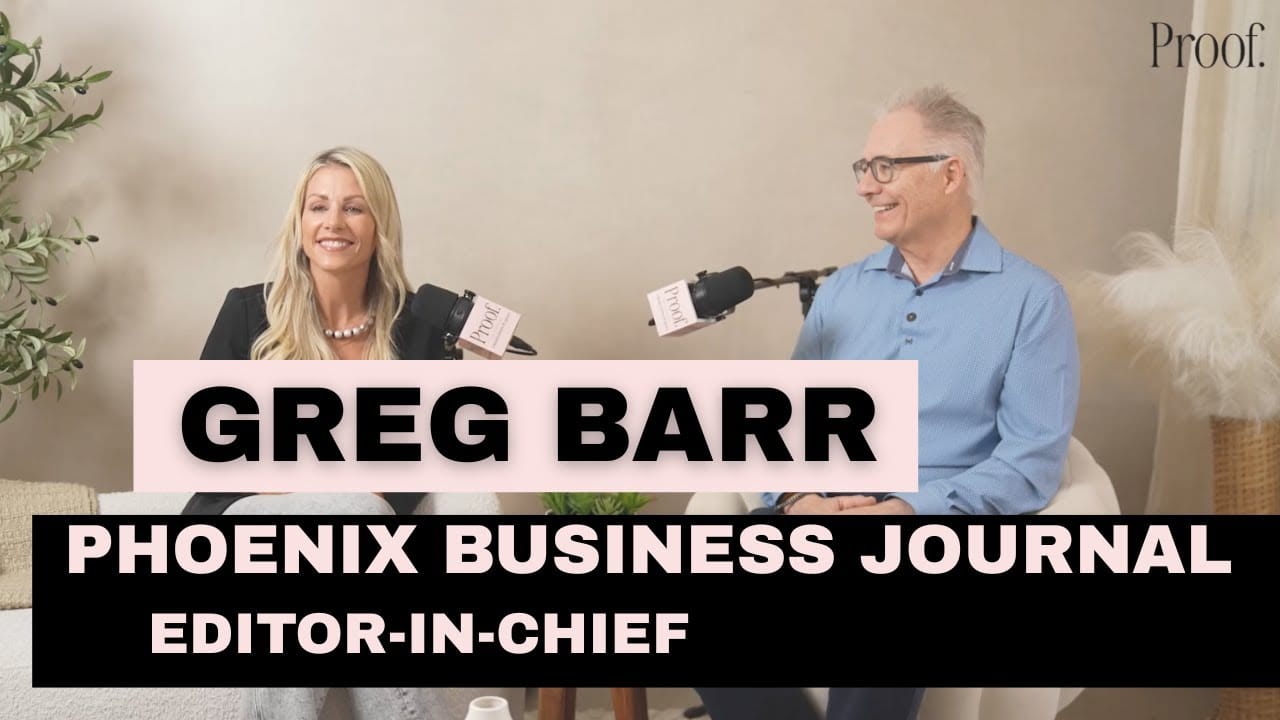
Who is Greg Barr?
Greg Barr has been editor in chief of the Phoenix Business Journal since 2018, responsible for the paper’s digital and print editorial operations and its startup publication AZ Inno. A native of Canada, Greg Barr worked as an investigative reporter at the Financial Times of Canada and as a writer and editor at the Ottawa Citizen, then spent 2006 to 2018 at the Houston Business Journal and Austin Business Journal before moving to Phoenix. He is quick to correct anyone who calls the Business Journal a weekly: it is a 24/7 online newsroom with a print edition.
In this Off Deadline conversation with Proof Publicity founder Melissa DiGianfilippo, Greg Barr traces a career that started when a bandmate helped him land a sportswriting job at a small paper near Ottawa. He describes his years as a full-time rock critic in the 1980s and 1990s, including covering opening night of the Rolling Stones’ Steel Wheels tour at Veterans Stadium in Philadelphia and hitching a ride out on one of the band’s equipment trucks, traveling with the Flying Fathers, a hockey team of Roman Catholic priests, and the mid-1990s East Texas assignment where he interviewed a Ku Klux Klan grand wizard and the Black attorney representing him.
Greg Barr also explains what business journalism looks like from the editor’s chair: the tedium of digging through thousands of documents for the kernel that becomes a story, the court case where a publicly traded company subpoenaed his notes, and why citing actual documents is a reporter’s best protection against libel. He still plays music at open mics around Phoenix, once got punched backstage by a singer with a number one Billboard hit who disliked a review, and says local and niche business journalism is as important as it has ever been.
What Greg Barr said on Off Deadline
“The most fortunate thing I’ve had in my career is being able to do so many different kinds of jobs within the industry and have so many different beats to cover.”
“It’s not really a weekly paper. It’s a 24/7 online paper.”
“To be able to find a kernel of something that turns into a bigger story, that’s, that’s kind of like the payoff thing.”
“It’s like searching for for gold. It’s like there’s something there. You know, there’s going to be something there. So keep going.”
“Citing documents is great. It gives you a lot of protection, from libel, citing court documents.”
“I think that’s the power of journalism and power of local journalism is still very, very important.”
How do you pitch the Phoenix Business Journal? Proof’s take
Three things worth taking from this. First, the Business Journal is a daily digital newsroom, so the old rhythm of pitching once a week for the print edition is gone. News breaks when it breaks, and a company that can confirm details the same day gets covered the same day. Second, Greg Barr’s reporters live in documents: filings, permits, court records, public bids. A pitch that arrives with the paper trail attached, or ahead of a filing the newsroom will find anyway, is doing the reporter’s work with them rather than against them. Third, his dream series is Phoenix versus Dallas and the other cities competing for relocations, and the Business Journal shares reporting across 46 American City Business Journals markets. Growth, relocation, hiring and investment stories with real numbers are the ones this newsroom is built for. Proof Publicity places Arizona professional services, real estate and healthcare clients in the Business Journal on exactly those angles.
Watch the full episode
Proof Publicity earns business press coverage for Arizona professional services, real estate and healthcare clients. See our B2B PR work.
Episode transcript
Read the full transcript
[0:00] Welcome to Off Deadline. I'm Melissa DiGianfilippo, and my guest today is Greg Barr, editor in chief of the Phoenix Business Journal. Welcome, Greg.
[0:00] Glad to be here.
[0:00] Greg Barr brings 40 years of experience as a journalist to us. Greg has been editor in chief of the Phoenix Business Journal since 2018. Responsible for the overall editorial vision and content of the publication. He previously held writing and editing positions at the Austin Business Journal and Houston Business Journal. A native of Canada, he worked at several newspapers there before moving to the US, including as an investigative reporter with the Financial Times of Canada and as a writer and editor with the Ottawa Citizen, one of Canada's largest dailies. I'm so happy that you took the time today.
[1:05] Well, I'm glad to be here. This will be fun.
[1:05] Yeah, and having a weekly paper like you're always on deadline.
[1:05] Oh, well, it's not really a weekly paper. It's a 24/7 online paper. It's. You know, it used to be just a weekly. I'm not anymore. Every day there's something happening.
[1:05] Yeah, yeah, yeah. Well, we're going deep today. Okay. So I want to start first to understand why journalism. And how did you get your first big break?
[1:25] Okay. Well, interesting question. Because my, you know, it wasn't like I early on decided I would this is what I'm going to do. I kind of fell into it, really. You know, I was a creative person. I knew that I was a musician, since I was a little kid, you know, piano lessons ordered by my grandmother. And then I moved in to rock bands when I was 12 years old. And so I was really creative. I had that half of my brain. And so then when I went to graduate, it, I didn't really wasn't really sure what I was going to do. And I ended up going into science of all these things. And, you know, I don't know how I was, you know, how I ended up there. But I thought, well, let's try that. It didn't work out.
[2:18] You know, science like you were trying to be at, like bio biology.
[2:18] You know, I was just thinking, I don't know, it was. I had high school teacher I had in biology. I thought he was a really cool person. And I thought, well, maybe I can do that. I really didn't know, but, I mean, I knew I was playing in the band in the background. And so that was always something interesting for me. But yeah, it didn't work out. So I had a couple of years of, in university, just not happy. And one day I ended up seeing a job ad to go work on the college radio station. Oh, okay. So I got somehow, you know, with no experience and doing it or whatever. I'm, like, suddenly there, I'm able to spin records in the middle of the night and thought, this is kind of interesting. And then, oh, I could get a job doing this. So I enrolled in journalism, and actually it was in radio and television journalism broadcasting. It wasn't print. So then I, I totally segue and the light bulbs went off and oh, I'm writing, I'm editing, I'm doing all of these things that were apparently that was the skills part of my part of my life that was unleashed, you know. So yeah. So that was great. But then even back then, when I graduated, it was tough to get a job. And so what am I going to do. Well, I took a job, just any job and then went back to school at night to take other journalism courses, you know, no. And then my break came because of my rock band.
[3:45] Oh, that's so cool.
[4:11] So I was playing in this rock band in this little town in near Ottawa, the capital of Canada, about 40 miles away, in a small town. And, you know, you just get around it. Well, what do you do for a living? So the the drummer says, oh, I'm the photographer for the little paper here in town. And I went, You have any job openings? He said, yeah, we need a sportswriter. And I got the job the next day.
[4:11] That's amazing. So your band, your hobby got you your career?
[4:31] Yeah, basically. And then. Yeah. So I. And I never ended up going back into TV or radio. I stayed in print the whole way from that minute forward.
[4:31] Wow. Did you. Was there any regrets there?
[4:31] No. Not really. Because again, it was all creativity, of course. And, you know, at the time when I got the job, you know, I loved sports. I loved writing about sports. I was into every single sport possible. Although I spent most of my time in freezing cold high school hockey.
[4:51] That's a Canada thing, right?
[4:51] For sure. Yeah. Now it's an all over thing, I get it. But like for me, growing up here wasn't a big thing here until it was. So that was anyway. But that's the weird connection I have. It was actually through the band that I got my first job.
[5:08] Wow. So cool. So I want to know, what was your. I can't believe they're paying me to do this moment that confirmed you had chosen the right profession.
[5:08] Sure. Well, that's. Stay with the music fan. You know, I've had one thing. The most fortunate thing I've had in my career is being able to do so many different kinds of jobs within the industry and have so many different beats to cover. Editor, writer, you know, just, you know, I pretty much done everything you could do in a newsroom over my career, which has been great. Yeah, at one point, I was a full time rock music critic. And so one of those. I can't pay it, you know, you can't believe you're getting paid for this. So, yeah, I was working in Ottawa and back in the days, you know, there was a long time in journalism in the early in the 80s and 90s. You know, there was a lot of unlimited budgets. You know, people had a lot of money and publishing and whatever. So people were spending a lot in advertising because there wasn't the internet. You could go, you know, so there was a lot of money for travel for journalists and things going on. So they paid for me to fly from Ottawa to Philadelphia to cover the opening night of the Steel Wheels Rolling Stones tour.
[6:15] Wow. And so that was one of those moments that is so cool to say that you not only were there, but you also cover that as your job.
[6:44] Yeah. Yeah. Yeah. And then there's. Yeah, I can tell you there's a funny, weird story attached to that. Okay. So, okay, this is it. Veterans Stadium is. Yeah, I don't know. I think they blew that up and built another one later. But that was the big stadium. That and of course yeah. So the concert was amazing. I remember they blew the power in the middle of the first song, like the whole place went black. And then five minutes of people screaming and then the power came on and they finished the song. And then off they went. But at the end of the show. So I was again, this was this, I had this, this computer was supposed computer back then is RadioShack computer. And it was like, you know, there's one screen of type you didn't know what you were writing, and it just took forever, you know? But anyway, I did all that. So by the time I finish, it was one really late by the time I had filed everything. And yeah, so I left Veterans Stadium. I had no idea where I was, what it was doing. This is, you know, Uber didn't exist.
[7:31] Yeah. And you didn't live there.
[7:31] Uber didn't exist. Whatever. Yeah. And I'm figuring out, well, I got to figure out where I'm going. And I walked around all the way around the stadium and I saw the big Rolling Stones, the trucks, you know, with the tongue on the side and the whole thing. And I saw a couple of people. So I walked over there and this, this woman jumped out of one of the cabs of the 18 wheelers and I said, oh, I'm trying to get. You have any idea where the Constellation Hotel is? She said, we're staying there. I'll drive, you know, on the tour bus. So no, the truck with all their equipment. So anyway, I'm on the truck with and she was she went through every red light pulling her big giant, blasting diesel horns. You know, back to the hotel at 130. At one in the morning.
[8:29] What a cool story. So there you go I love that. That is like it's a once in a lifetime experience for sure. You know what reporting experience brought you the most pure joy or satisfaction of your career so far?
[8:54] Well, there's a lot. One of the most interesting and fulfilling ones, was in Canada again. Sports this time. There was, everybody knows the Harlem Globetrotters. Of course there was in Canada at one point there was a hockey team made up of Roman Catholic priests, and they were called the Flying Fathers.
[8:54] They sounds like the start of a joke.
[9:25] Yeah. And they but they would go from town to town and some bigger cities too. But they would go and play a charity hockey game against the maybe the police and firemen of the town and, you know, that kind of thing, and raise money for a specific cause and charity in that town and then move on to the next town and whatever they would do. And they were a really pretty loose group of people that these priests that got together to, to play. Yeah, a few, a couple of Americans actually were in there too. Wow. But, I got a chance to, I got an assignment with the same paper that flew me to the stones. Yeah, to travel with these priests for about eight days on their bus. Going to 2 or 3 really small towns on the east coast of Canada. And it was just an amazing experience. And, you know, just to be involved, to see, you know, what they meant to these small towns and what they meant to the kids and what they meant. And then some of the unprintable antics that I, you know, the things that I saw that you wouldn't expect, like, was that are they really priests?
[10:28] Yeah, exactly. Yeah. There were some poker games like, oh, I love it. It is so funny. And how, like, what a unique experience to just, like, be able to be in that inner circle for a minute I'm sure.
[10:34] Yeah. And you know, but it was just these people were really, they were doing a great thing. And then it kind of you know it rubs off on you and you're part of it.
[10:47] And so that always stuck with me. Very cool. What assignment revealed something about humanity or society that might have altered your worldview in some way?
[10:56] It is a lot to draw on which I'm fortunate to be able to say. Yeah. Let's move from Canada now to Texas. Okay. I had moved to Canada, to Texas, of all places, and was I had worked for. Yeah, I ended up working for the Houston Business Journal. That was how I got into the business journal world. But before that, I was I did a lot of freelancing, and I actually ended up working, doing stuff for Canadian papers. Who were Canada's. You know, it was fascinated with Texas. Wow. And, you know, anything? You know, the Wild West just just sort of the vibe. And, and there's a lot of wild things happened in Texas to cover politically and business. It was just a lot of stuff. I'll try and make this as clear as possible to explain the profound impact that this had. I, I knew and a there was an attorney in Galveston, Texas, which is an island off the coast of Texas.
[11:57] A lot of people don't really know that it's an island. Yeah.
[11:58] Anyway, he lived in this small town. He was, a black attorney. Anthony Griffin and turned out that he, was given a pro-bono job, you know, through, you know, one of the, one of the organizations that sets those things up and his client that he was going to represent was a grand wizard of the Ku Klux Klan.
[12:32] Oh my God. Wow.
[12:33] And he's a black attorney in Texas. In Texas. Okay, so I got to go interview the Klan guy about the experience. I know I knew Anthony anyway. Yeah. So I so I, I went to East Texas, a place called orange. Very Klan heavy Catholic place.
[12:54] Oh, and here was this.
[12:55] This I mean this was in the mid 90s okay. I just remember I so this guy you know he was, he was he represented him and a it was a tax evasion case. And you know back in the FBI you know all the dealings with the Klan, the way they ended up really busting people like that was over something like tax evasion. That was kind of their main, the main way they could try. And, you know, get at these people. So you sat down with a guy. He had a suit and tie on. You know, he was coming out of the courtroom, and basically he just described.
[13:34] Yeah. His jaw dropped when he turned the corner to meet his new attorney, I'm sure.
[13:37] But in the end, it taught me a lot about humanity and things and, you know, and and the attorney got him off the charges. He he defended him. That was, you know, because the ACLU. So he defended him and got him off.
[13:56] Wow. That is all. There's so many factors in that story that are so bonkers. Yeah. So you could say with someone with the Klan, humanity at its worst, but then humanity at its best with what the attorney did to put things aside and do what he did.
[14:18] Yeah. It's very, very impressive. And what a unique experience.
[14:21] Yeah. I've never heard a story like that.
[14:24] Yeah. Yeah. So. Yeah. Yeah. That was. Yeah, very, very profound.
[14:30] Yeah. Can you share a time when your most impactful work happened behind the scenes in ways that your audience never even knew?
[14:37] Even now, you know, there's a lot of stuff that goes on that can be tedious. And, you know, you're digging through, especially in business now. We, you know, at the we have to dig through so many documents all the time that people think they see the story. They don't know how long it takes to weed through things and find things like that. So, to be able to find a kernel of something that turns into a bigger story, that's, that's kind of like the payoff thing. And, you know, and you see that, you see that. I see that through the eyes of the reporters who work for me now. I don't think there's one specific thing, but I wanted to try and say that, you know, the amount of tedium involved in looking through these things can end up with, you know, an amazing, an amazing payoff at the end.
[15:30] Yeah. And a lot of times I was talking with another reporter recently who said those best stories are exactly that. It's like digging into paper work and seeing something that no one else has seen yet. And and being the first to bring it to light, it's that's a big it's it takes a lot of work and time.
[15:47] Absolutely. Yeah. Yeah. For sure. It's, Yeah, it it's, you know, it's a rewarding thing. I mean, you've it's it's I worked in business a long time. Done all the other things, too, with music and covering crime and all of those things. But, looking through public documents, you know, is can be a treasure trove, really, if you want to, you know, and if you take that attitude, then it opens the doors to really, you know, looking and not like, oh my gosh, I got another 10,000 documents to read it. It's like searching for for gold. It's like there's something there. You know, there's going to be something there. So keep going.
[16:30] Yeah, I love that. Is there a story or a moment from your career that still weighs on you, or keeps you up at night?
[16:39] I don't think really, you know, really weighs on me. You know, there's been some tough times I've had. You know, I was involved in a court case at one time where you know, you have your notes subpoenaed, and it's, you know, it's a, you know, it was, a case with a publicly traded company and they, you know, and they brought the case against the newspaper. I was able to get through that, but that was like that kept me up at night, that whole two week experience that was, you know, really difficult in the end. I felt vindicated because as a result of that, I was allowed access to. The CEO and other people. I got to fly back to their headquarters and do follow up interviews, and was able to write a bigger story that just went into a lot of issues with their finances and whatever that came to light. But of course, you know, at that point, they there was nothing, nothing. It was all it was all completely provable stuff. So there was nothing, no, no issues after that was resolved.
[17:42] Yeah. Wow. But like that feeling of am I even though you knew you didn't do anything wrong, I'm sure. Yeah. That feeling of like, what could this result in? Must be very scary.
[17:56] Yeah, well it was. Yeah, again, you know, you as a journalist, you're always, you know, someone doesn't like you at all times. You're always worried about, you know, you always got to be very vigilant. And this is what I do. I was the editor. We have to be very vigilant on how we cover anything to do that has a, you know, a legal edge to it. You know, citing documents is great. It gives you a lot of protection, from libel, citing court documents. Actual pieces of paper. Other. I've seen some, you know, publications get into trouble when they're talking about things, and they don't have the real paper trail to back it up.
[18:34] Yeah, that's when there's a real like, you have to be really, really, really careful with that kind of thing.
[18:40] Yeah. And especially with the publicly traded company. But any company I'm sure. But that's they have the money and they will sure they'll pursue, what unconventional path or experience in your life has unexpectedly made you a better journalist? Well, I think, I think the, you know, the fact that I ended up falling into it because of my band. Yeah, I have for a few years, you know, I, I've played in bands and worked as a journalist. And, at one point, oh my God, I had to decide. One point, I was like, I was covering sports. And what do you do at sports where you cover games for the games there at night? And when do you play in a band while you play a band? Late at night? So they were clashing at one point, you know, and at one point I really I had to make the horrific decision of quitting the band, you know, because it was it was bringing in some money, but it wasn't my main thing. So I picked it up again and figured out, oh, I gotta balance this out. I got to play, you know, I got to play music. But I always think that that's kind of been, I don't know, been part of. It's those two things together. Playing music and writing has always been something that's been in sync for me and has been part of my mojo.
[19:55] That's awesome. And I it really has been something that's like, helped you get your start in journalism and that you kind of carried along the way. And you still playing music today, don't you?
[19:55] Yeah. I mean, I've, I haven't played as much since I moved to Phoenix. I was playing a lot when I was in Texas. I played in a couple of bands that played big venues like House of Blues. You know, had we're doing really well. But then when I and I moved here, I've played in a couple of, I've done a couple of things. Played a few gigs last year. I still like to get out and go to, open mic and play stuff. But yeah, just want to, you know, as my job is just so very hectic and busy right now, I'm not doing a full time other music thing, but someday.
[20:35] Yeah, that's, you know, someday. I love that you can keep your hobby. And, like, it's been such a big part of your whole life, and you still make time for it. I think that's so important for everyone.
[20:52] Yeah. For sure. It probably makes me more creative, honestly.
[20:52] Well, as I say, I think it just you're constantly using that, you know, creativity and, you know, they're different. It's slightly different. It's slightly different things. But it still comes from the same, same muscle. But I like but it's what it is. It's kind of like if people, people play golf and they kind of getting a zone and you and you're playing golf, you know, you're just concentrating on that and you're thinking and you're, you know, and it's a feeling.
[21:10] Or when I'm playing music, it's like everything else shuts off. Yeah. So you can just be in the moment. I'm in the moment and I'm doing that.
[21:27] That's right. And that's a good thing to do. Okay. We're in rapid fire. Okay. So your job is to just say the first thing that comes to your mind, okay? What's the most outrageous behavior you've witnessed from a celebrity, a politician, a public figure in your reporting?
[21:27] Well, when I was the rock critic, that was quite a few years. I saw a lot of outrageous behavior. I'm sure, I can say that I got punched by a high profile singer who had a number one Billboard hit backstage at a concert because she didn't like something I wrote about her.
[21:53] Wow. The. I don't think many people can say that. So did you retaliate?
[21:53] No. But in the end, she faced big issues with with being busted for cocaine use.
[22:26] Okay. Well, then, so there you go. It comes the karma.
[22:26] Yep. Karma comes around. There you go.
[22:26] Most outrageous excuse you've ever used to get access to a story.
[22:26] I don't know if, I excuse one thing that does come to mind when you say that, though, is. I, master, I did, master the art of reading upside down. Oh, and got a story. One time when I was interviewing an executive and the papers on his desk, I was able to read them and had gave me a big clue on a on a story that I was able to follow up on.
[22:49] Amazing what a skill, a story you cover if, well, you're the editor, but I guess if your publisher said unlimited budget go wild,
[22:49] yeah, well, let's, you know, to bring it into perspective with what I do with the Business Journal, I think something it would be really, no, you know, with, with a no budgetary constraints, no constraints. We write a lot about Arizona and, and the Valley's competitiveness against other states and other businesses, you know, for relocation. We're always trying to attract companies here. Yeah. We have, you know, our arch enemy city like Dallas is the one that we are always Phoenix was always going up against for business relocation. It I think if it was if we had unlimited budget, it would be great to go to do it. You know, do a big do a series to go to each one of those cities and pick them apart in terms of what they do and being able to show everyone how this competitive thing works across the country. That would be, yeah. If I could go go to eight different cities and do that, that would be good,
[23:51] I love it. Great idea. We're going to pitch that to someone. So your publisher approach maybe to the Business Journal like network.
[24:06] Right. You know. Yeah. Well, we do keep tabs with the stuff, you know, because, you know, we're we're part of American City business journals and we're in 46 cities. Yeah. So we do work with other reporters and other cities when we see similar things or people are bidding on the same project or comparing some stuff with other cities, we are able to do that.
[24:31] But I want to do it all in person. I think I love it.
[24:31] If I weren't a journalist, I'd be a full time musician.
[24:31] I knew you were going to say that. It's like almost too easy. and finally, what's one piece of advice you give to someone just starting in journalism today?
[24:58] Well, I would say, you know, it's, there was a time period where it was, you know, the gloomiest thing in the world was to be, you know.
[24:58] Oh, you mean you want to be a journalist? Are you crazy?
[24:58] I think, you know, there's so much, local, you know, so much news and powerful news that comes out of local publications, publications that are focused just on us on their own niche market. Yeah. You know, we're, you know, I think that's the power of journalism and power of local journalism is still very, very important. And I see that. And, you know, we talk to the interns that come through, we have one in our newsroom now. We have another one started. We'll have our second one starting on Monday. And, you know, there's there's a lot that there's a lot to do in journalism still, there's a lot of good work to do to keep, powerful people honest. And just, you know, and there's and business news is one of those things that's never going to go away. Yeah. So, you know, I think that's, I think it's still a good time to be in journalism, no matter what. Was said a few years ago, I think, you know, after the internet came in and changed so much upside down, then, you know, then people so where do I how where how do I have a path forward in this, you know, but, you know, there are paths forward and, you know, there's, you know, and, it's good to see a lot of so many people still enrolling in journalism and wanting to do journalism. That hasn't stopped.
[26:18] Yeah. That's great. So a positive message. Still a great career path. Good I love it. Thank you so much for being here Greg. It was a pleasure. I really enjoyed it.