
Ian Schwartz, Arizona’s Family, on Weather, Wildfires and Being Yourself
Ian Schwartz, morning meteorologist and reporter at Arizona’s Family (3TV and CBS 5), an Arizona native with nearly 20 years in news across Illinois, Albuquerque, Sacramento and Phoenix.
Who is Ian Schwartz?
Ian Schwartz is the morning meteorologist and a reporter at Arizona’s Family, with nearly 20 years in television news. An Arizona native and the youngest of seven, Ian Schwartz stumbled into journalism at Mesa Community College when an instructor, Jack Mullins, pushed him to keep writing for the Mesa Legend, discovered video reporting at Arizona State University, worked as a hard news reporter in Illinois and New Mexico, completed Mississippi State’s meteorology program while in Albuquerque, forecast in Sacramento and worked his way home to Phoenix. He also volunteers with Stop Our Stigma, a nonprofit that works to destigmatize mental health help for first responders.
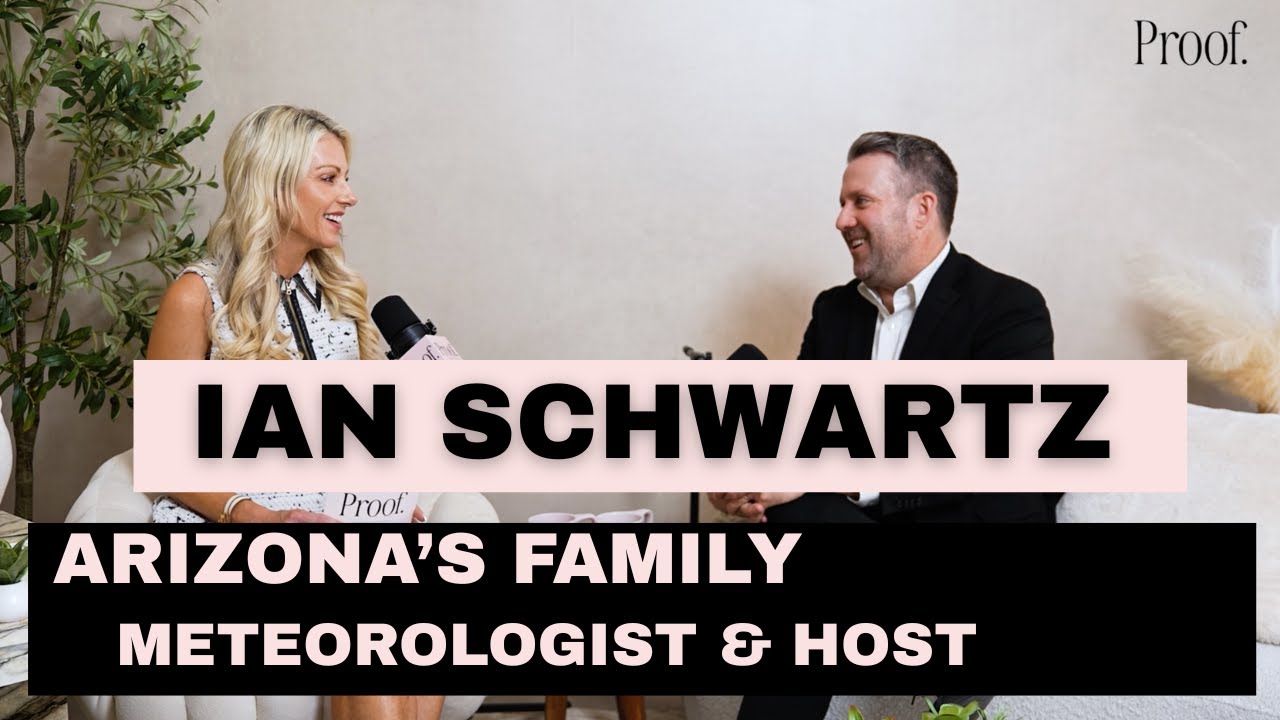
In this Off Deadline conversation with Proof Publicity founder Melissa DiGianfilippo, Ian Schwartz describes being sent to Maui to cover the Lahaina wildfires and finding the real aloha spirit in survivors helping each other, and how he approaches people who have lost everything: listen first, be real, and do right by them. He talks about a brutal Midwest winter that nearly sent him to Second City instead of a newsroom, about staying in touch with mentors for years until a path back to Arizona opened, and about how small the television business really is. Every forecast, he explains, is ad-libbed with nothing but slides.
Ian Schwartz also revisits a murder trial in New Mexico that still haunts him, the dark humor and time away from the news that keep him level, and the quiet thank-you notes from viewers he never reads on air because it would feel like bragging. He wades into the annual haboob versus dust storm argument, admits his childhood was spent performing for the bathroom mirror, and shares the headline he is proudest of writing: Man punches bear to save his dog.
What Ian Schwartz said on Off Deadline
“I think you have to really listen and let people know that you really are there listening, and you want to do right by them.”
“Listening and being myself took many years to kind of figure that out.”
“So you’re wasting your time if you’re trying to put on a persona and just being real and being yourself is like so, so, so valuable.”
“I actually do work for a nonprofit called Stop Our Stigma. That is really to help destigmatize the the stigma that exists with first responders and, like, needing help.”
“I mean basically a weather forecast is a a SlideShare.”
“Man punches bear to save his dog.”
How do you pitch Arizona’s Family morning news? Proof’s take
Three things worth taking from this. First, Ian Schwartz says viewers see through a persona every time, and he applies the same test to the people he interviews. Spokespeople who are real, plain-spoken and willing to say what they do not know come across better on morning television than polished ones. Second, he is a meteorologist and a reporter, which means weather-adjacent stories are a genuine opening: monsoon prep, heat safety, how a business or hospital handles a storm season. Give him the person and the visual, not the press release. Third, he built his career on relationships kept warm for years, and he says the industry is tiny. Treat every producer and reporter as someone you will work with again, because you will. Proof Publicity pitches Arizona’s Family and the other Phoenix morning shows for healthcare, hospitality and community clients, and we brief our clients to be exactly the kind of guest he describes.
Watch the full episode
Proof Publicity earns local television coverage for Arizona healthcare providers, hospitals and community health programs. See our healthcare PR work.
Episode transcript
Read the full transcript
[0:00] To be. Welcome to Off Deadline. I'm Melissa DiGianfilippo, and my guest today is Ian Schwartz. Ian Schwartz has nearly 20 years in the news business as a reporter, meteorologist and more. A native of Arizona. Ian worked around the country in Illinois, Albuquerque and Sacramento before returning home to Phoenix at Easy Family, where you can watch him in the morning forecasting the weather and having fun in the field. On Good Morning, Arizona. He has covered flash floods, blizzards, tornadoes, wildfires, droughts, and just about everything weather can bring. He also recently got married, so congrats Ian. Thank you so much for being here.
[0:45] That's the real natural disaster. Yeah. Surviving a 14 year relationship.
[0:45] Adam, as a woman who is happily divorced. Yes, I agree. I mean, really, congratulations, though. That's, like, very exciting.
[1:10] Yeah. Pretty exciting. I was actually married in December, in Albuquerque, where my now husband.
[1:10] That's so weird. Isn't that crazy?
[1:10] Fast. That, like, just like. Wait a second. So we did, like, the official ceremony in Albuquerque, and then we did, like, the wedding kind of mixture. Party here before summer.
[1:10] Yeah. Yeah. I saw on Instagram all the reporters from all over the valley. Like, it was like one story after the other from your wedding. Like, that's really cool.
[1:32] Yeah, it was a nice showing from them. Yeah. And thank you for having me here. This. Happy to, be doing this.
[1:32] And really excited to have you. I love watching you. My team loves watching you. You bring really great energy to, you know, our TV screens and computer screens and phone screen. So, excited to go behind the scenes with you today. I'd like to start with your back story a little bit. Why did you choose journalism and how did you get your start?
[1:48] It was almost like a mistake, actually. I was an MC. I was kind of a lost student. I didn't know what I wanted to do. And so it was taking classes and everything from science to jazz to you name it. And then I tried, this media class, and I think because I thought it was gonna be, like, an easier. I wasn't a good student for sure, and I kind of liked it. And then I took another class, and then I took another class, and I got there and he says, you're going to be writing for the The Mesa Legend Mix newspaper. And I said, oh, my, I made a mistake. I think I got ahead of myself. I was supposed to take like another class before I got this and this, instructor who used to work for Miami Herald, Jack Mullins. He said, you know what? Stick with it. We're not gonna let you fail. You know, we'll we'll edit your stories, and, you know, we're not gonna let you sound stupid in this and that. And then I started writing for this newspaper, and I loved it. And then I eventually transferred to ASU. And I've always been into cameras and tech and editing. I said, oh, wait, there's a there's like a video version of reporting. And so I started doing that and I started doing well and I got good grades. And once I found something I liked then I kind of excelled. And so yeah, I always thought I was going to be in media or have like a public facing job. But I didn't really know the route how I would achieve it.
[3:22] Yeah. That's interesting. I think like it takes a certain personality type to be comfortable in what you do and not only be comfortable, but like be comedic and have fun and natural and has that always been comfortable for you?
[3:47] I think so, I've always people have always said I'm funny and I've always like to kind of perform. I'm the youngest child, so that makes sense. Like desperate for attention, I guess in a big family,
[3:47] there was seven people in the house where you grew up. Wow. Where?
[3:47] We grew up in Mesa. So the youngest in a big family. And then I also had tons of influences from my brothers and sisters and some of them are animated as well. So I think I kind of like soaked up everything from them. Yeah. And, I was more of a serious reporter when I first started out, so there wasn't a ton of room to, like, be zany. Yeah. But I had my own little, you know, quirks. But now that I do kind of lighter stuff, I can really let that go. Go wild.
[4:26] Yeah, that's really fun. Well, thank you for that. I'm curious what assignment has revealed something about humanity or society that might have really altered your worldview?
[4:26] Oh, that's a good question. I think, you know, neutrally, I, maybe a couple of years now. They sent me to, Maui after the Lahaina wildfires, and I had actually never been to Hawaii. Yeah. So the whole crazy, you know, reason to go, I guess. And people had talked about, like, the aloha spirit and I had heard about it. I almost thought it was just kind of like a tagline or like, you know, no catchy marketing thing. The Commerce Department or the Tourism Department came up with it. But in this, face of disaster, where all these homes had burned down days later, the government had provided no help and people were out of gas and they were living in parks and all this stuff, these, kind of roadside aid stand started popping up where people could go, to basically little nurse triage. They could get food, they could get water, and all these strangers were just helping each other. And it was so incredible. It was almost emotional, like brought tears to your eye to see all of these people doing these amazing things. And I was like, oh, that's the spirit. And I was like, oh, that's like a real thing. So I guess in the face of disaster, seeing people being able to like, pause and, still like, have good in them and not going to, oh my gosh, the world is ending and stuff like that. So that's always kind of inspiring. That's the most recent one. There have been other wildfires that I've worked on in California where I saw, you know, similar things where people like coming together and really making a difference. And it's like, okay, this is kind of contagious.
[6:06] Yeah. And I imagine that's so much harder to to cover something like that and have to be in people's faces asking them really tough questions when like their life is decimated or their family, they don't know where their family is or in a wildfire or in, gosh, I mean, so much in Maui was so scary. When you think about no one could get to them, they couldn't get through to people like, how did how do you do that?
[6:40] I think you have to really listen and let people know that you really are there listening, and you want to do right by them. Yeah. You know, if you fly in there with a camera and you're trying to be fast about it, I mean, you really have to finesse the situation. And especially in Hawaii, where, you know, not all of them take kindly to, you know, mainlanders. Yeah, there's a whole history, with the Hawaiian people. And so here you got this guy, like, from Phoenix, like, what are you doing here? We were there helping our sister station. But when you just talk to people and, you're just real with them and, explain the best you can, and a lot of times, like, hey, like, like I wish I wasn't here. Yeah, like, but this is, you know, where we are and what city or what message and what they really want me to get out was a nobody help them. Nobody, nobody help them. And they were stuck and they were mad. And they said, don't let that get lost in the stories and know about you know, make sure people know that.
[7:45] That's great. That's really important work. Every journalist likely faces moments of doubt. Can you share a time when maybe you reached a professional crossroads, and how did you navigate that?
[7:45] Probably living through a midwest winter. Oh, God.
[7:45] I went to school at college in Ohio. Believe me, I know.
[7:45] I was born and raised here in Phoenix and Mesa specifically. So being plucked from the Sonoran Desert and dropped in the middle of central Illinois and is, you know, the winters are long and tough. The pay wasn't great, which I knew, but Chicago was so close and I thought, well, should I get out of there? Should I be doing stand up comedy? Should I do more of the fun feature things that I do now or early on as a reporter? I thought maybe I should just quit and go to Second City Chicago and try something else. So there was a couple times, I mean, I'm sure I googled second city classes. And I, I still enjoyed doing the hard news and as a reporter, but there was a couple of times where that happened. But then I kept with it and eventually kind of found a path to what I get to do now.
[8:59] Yeah. And did you have to make strategic decisions to get back to Arizona? Like, did you know that was always the path?
[8:59] Yeah, I think I always wanted to come home. At one point, I kind of went from Illinois to New Mexico to Sacramento, and then along the way I started my, weather schooling. So through Mississippi State, a lot of TV people will do that. It's almost like an online NBA for weather allows you to keep working while getting schooling for weather. Yeah. So I started that in Albuquerque, and then I transitioned into kind of weather in Sacramento. And I stayed in touch with a lot of people. I mean, I've seen McLaughlin. I've been I think I'd send them a lot of messages over the years like, hey, can you look at this resume tape? And there was some great mentors who were happy to help and kind of give me advice and just fostering those connections and finessing them and making sure, yeah, but eventually that was definitely the plan to get back here. So yeah, I think staying in touch was the main thing.
[9:45] Yeah. Smart and not and having a good reputation. Not burning any bridges along the way because despite being different markets, I imagine the TV world small.
[10:03] You know tiny. Yeah. I'll get a call from someone I worked with 15 years ago and they'll say, hey, so-and-so worked at your station. What do you know about that? Yeah. Or some someone I maybe I work with two stations ago, and, Yeah, it's a very, very small world.
[10:27] Yeah. Can you talk about a moment when you witnessed your journalism make a tangible, positive difference in someone's life?
[10:27] There's a lot of stories as far as hard news reporting goes, helping people out where they had nowhere else to turn. The city wasn't helping them. Or it could have been, you know, medical bills or, you know, whatever. But in my current role, I think during Covid, being able to kind of make people laugh. Yeah. And maybe take their mind away from things. I mean, things are still, you know, it's a topsy turvy world always. And the only real constant is chaos. So I got a lot of messages from people saying, thank you so much. It's just refreshing to be able to kind of get a break from everything and laugh, or I've had, you know, viewers who had had a medical procedure and they were stuck at home for 2 or 3 weeks, and so they'd say, oh my gosh, you're cracking me up. And it helps home so much to get out of, hip surgery. So it's small. I mean, I's just a joke or this or that. But it made an impact and, I love hearing, you know, those stories. When people reach out and they say, oh, I got I got to forget about my problems or the world's problems for, just a little bit.
[11:33] Yeah. That's got to be a real good feeling, like. And also probably makes you feel like you're doing the right thing. Like you're in the right career.
[11:52] Yeah. You know, and I know that the joke was funny because in the studio sometimes, you know, laugh. You're like, are you even listening? Know it's usually the anchor's not listening. And it's like, hey, hello, is this thing. Oh, hi. That's so funny.
[12:08] Yeah. Like talk talkbacks. I'm sure sometimes get a little bit like. Was there a moment when, you know, in your career that maybe still weighs on you or keeps you up at night, maybe a story you covered or something you saw that? Like you just can't get out of your mind?
[12:08] Yeah. This, I mean, you, unfortunately, or sometimes pretty early on the scene and, you know, you see, maybe dead bodies or something like that. Yeah. Or charred homes. I've walked through dozens and dozens of homes that have burned down wildfires. But there was a really this is back when I did that more serious stuff. I was working in New Mexico and this, young man, I think he was on drugs. He was 18 years old. He was on the Navajo Nation, and there was a nun who had a convent up there, in northwestern New Mexico. And this this guy, he murdered a nun, which is like, obviously murders. Horrific. But it's like, oh, my God, a nun. Yeah. And I was in court sitting, I don't know, ten feet away from him. And I was just thinking about like, what? Obviously the drugs I think played into it, but it was just so weird sitting so close to maybe from me to where this camera is and thinking, this kid is 18 years old and he did, and not get into the details of the incident, but it was just so bizarre to be so close to, a guy who did something so, so horrific. Yeah. And being so young. And it was almost like, I want to get in his head at the same time, I did not want to get into his, yeah, it's probably very dark and, you know, troubling place.
[13:37] Yeah, absolutely. And like when you experience those things because you've seen a lot of things, I'm sure, that are not happy moments, how do you take care of your own mental health? Because I imagine you've had to learn tactics to deal with things like that.
[13:56] Probably. Humor. Yeah. Dark humor. Yeah. You know, half of what is on the news or half of what we see and, you know, police reports can't even make it to the news. I mean, it's so graphic. And unfortunately, you have to read these things, especially crimes against children. That is just horrific when you hear about some of the things that sick, sick individuals do to children. Yeah. And maybe humor and just putting away, not staying entrenched in the news, like actually taking a break, you know? Okay, I go home. I'm not going to necessarily immediately turn on the news and then watch more horrific storytelling. So I think stepping away from whatever it is you do, it does help.
[14:35] Yeah. Yeah, that's that's a good tactic. And just to remember, like it's okay to turn it off, you don't have to, you know, always be on.
[14:35] Right. Yeah. And trenchant I mean, big story. I remember those, wildfires from Maui. I was always on Twitter. I was, I was like, okay, I need this. I need to back up here. Like, I'm off the clock. Like, let's take a break. This is going to be there tomorrow. Yeah. You know, and stuff like that. And there's definitely people who deal with a lot worse. I mean, the first responders. Hey, I don't know how they do it because they see things that we don't, you know, even get close to. Yeah. I, I actually do work for a nonprofit called Stop Our Stigma. That is really to help destigmatize the the stigma that exists with first responders and, like, needing help. And it's it's a big problem for me. It's very scary.
[15:14] Was there a moment that's your proudest professional achievement that maybe never got the recognition you felt like it deserved?
[15:36] Oh, gosh, that is a good question. Did I write an answer down? No answer to that question. I think that question, yeah. By the way, you had very good questions sometimes for very, very good questions that I think it's that, those messages I get, you know, someone sending a kind note about how you really made their day. Like, I don't broadcast those on air. That would be bragging. Like bragging. Bragging. And I don't, you know, necessarily march those over to my boss. But they're personal messages that I get where people say that I made a difference on the small, small scale. So those happen periodically. Or someone I bump into at the grocery store or wherever, and they kind of convey those things about humor and getting to relax and, you know, breaking up the, the, some of the bad things that you can see in newscasts. Yeah. So yeah, I think, though kind of all tied together kind of I quietly and and proud of those. Yeah. Like to hear them and know that I'm connecting because you're literally in the studio and there's just a bunch of bright lights and there's a camera, and you know what? It goes out. It's like, I. Oh, people like, yeah. Did it connect to that? Resonate.
[16:45] Yeah, yeah. And it's that there's probably also negative feedback that you deal with. And I imagine with social media in the last ten years, your job has completely changed. But like also people feel like they have this direct line to you. Right?
[16:45] You know, I'm, somewhat fortunate. I don't get a ton of hate mail. Which is good. I would say there's a lot of craziness as far as the weather and people, when to argue about really dumb stuff. You know, whether it's a dust storm or a boob. Yeah. Like that train is never late. Every single summer, you know, we have a weather picture page and the first dust storm that comes up and like, oh, boy, here we go. They're going to start arguing about a boom versus a dust storm. What is it? It's like, people, it's not that serious.
[17:28] What's the difference, though?
[17:28] Legit. I mean, a boob would be a large, large, large, large dust storm. I don't know the exact, you know, like, how do you measure it? It's 5000ft or. You know how high it is a term that's mainly used in the Middle East for these massive, massive dust storms. They seem, I think, a bit more than we do, but we can get ones that kind of rival and are at least on par with what they see. Yeah, and it is an meteorological text. It's just wasn't a word. We think. You know what? This sounds funny. Let's start saying it's the most random word really like it is. I feel like when I first heard it, I'm like, oh, that is not real. You're like, wait, playing a joke on me? Totally. Who wrote this? A 13 year old, literally. They're like, oh, let's just like kaboom. Come on, that's going to be funny.
[18:11] Yeah. No, but I social media must make it awesome and hard, you know?
[18:26] Yeah. For the most part, it's all good. Yeah. If you were to send me a lot of reels, and I can't, I can't start. I already get too many from my friends. I cannot onboard any more. No more reels. So no more reels for Ian. Guys, I can't I mean, I I'd have to quit my job to respond.
[18:44] Oh, that's so funny. It's good they love you though. That's a sign of love. I think exactly. So what childhood dream or obsession still influences you today in your reporting or your life or other unexpected ways?
[18:44] I think, I guess entertaining and performing, you know? Yeah, I was a kid when I was a kid. I remember, our bathroom, the downstairs bathroom, the toilet faced the mirror, and whenever I was, whatever I was doing there, I would make a lot of faces and do voices and kind of, like, perform in the bathroom. And I think that kind of stuck with me in a way. I used to think, oh, I want to be on SNL, and I want to do that. And I don't know if I loved comedy enough to pursue that, because that is a very, very hard career. Yeah. This was rewarding and also kind of gave me the avenue to do that performance in an aspect. Yeah, there's a serious stuff about, you know, the news and broadcasting and, truth telling and holding powerful accountable and all those things, which I don't do as much more in my current role. Yeah. But I think the, the performance aspect and making people laugh. Yeah. That's what I've always loved to do that. And, now I get paid to do that. Yeah. In addition to the, you know, the wedding, obviously there's a tornado warning. We're not telling jokes like, you know, the appropriate. Yeah, time and place, but sunny and 90 for seven days. Yeah. There's a little more. More room for that.
[20:01] Absolutely. And you add them probably a ton. Right.
[20:01] It's all out them. It's all ad lib. I mean basically a weather forecast is a a SlideShare.
[20:23] Is that what the, yeah that that makes sense. It's like your PowerPoint. Where on that.
[20:23] Yep. Okay. I mean yeah I don't that's coming bankrupt or not. So it's based I mean those are your notes. So you, you know, create the slides. But there's no teleprompter, no script in there. Okay. Yeah. So any time you see someone doing the weather, it's usually just all ad lib.
[20:43] Oh, wow. I have no idea. No note cards.
[20:43] The anchors, usually have scripts in there, and they tweak their scripts and stuff like that, but for the most part, just about any weather forecast you see will be at work.
[20:43] Yeah. Interesting. Learn something new. Okay. We're getting into our rapid fire section to end. Oh, so I'm going to ask you a question, and I just go with the first thing that comes to mind. Okay? This could be dangerous. Could be a dangerous secret weapon to get you through a rough deadline day. What's your coffee order?
[21:02] Simple. Pike's Place. Babies whisper of cream. Babies whisper.
[21:02] It's kind of like my mimosa. A baby's whisper of orange juice.
[21:02] Oh, I was gonna say yes.
[21:02] Yep. That's it. Most bizarre place you've ever conducted an interview.
[21:27] Oh, my gosh, a hot air balloon. Oh, in the air. Yes. Albuquerque. Balloon fiesta.
[21:27] I want to go to that so that it's really, really neat. Even when I used to have it at Westworld. Now it's out like far. And Chandler, I think.
[21:27] But when I was young, I would go to the one out here, and it was so cool. I was in Albuquerque like, there's 3 to 500 balloons and nice and cool. You get a delicious breakfast burrito, maybe a little, fireball or something. Yeah. And they do a really neat thing where they stay grounded and they call them, balloon glows. And so they, fire up all of the burners. So they're kind of inflated and it looks like a pinball machine. All light, all lit up. Definitely worth checking out.
[22:06] Yeah. For sure. Your secret journalistic superpower.
[22:06] Listening and being myself took many years to kind of figure that out. You know, thinking, well, I need to do this and do that, but really, well, first of all, the viewers can see right through it always. So you're wasting your time if you're trying to put on a persona and just being real and being yourself is like so, so, so valuable.
[22:36] Yeah, absolutely. The best headline you ever wrote or wished you wrote.
[22:36] Man punches bear to save his dog.
[22:36] No way. You really wrote that
[22:36] I know I like I did a story. Yeah. A guy in, Placer County when I was in Sacramento. He had this tiny little Chihuahua, and he's just. He's just marine. He's retired, and he went out on his porch. And then there was this big bear, and he scooped or he ran up to a bear or something. And this guy was such a character, and he socked this bear in the face, to save his dog. During the interview, he said, no one's going to hurt my little pooch. Big burly, tough guy. And he's at this launch a Wawa after he just punched a bear. So that's awesome. I, I will never forget that. Carl Moore was like, wow, I will never get his name back. I was a legend. He was literally one of the most interesting people I ever interviewed. And then during the interview, I'm chatting with his buddy and they're all marine buddies, like, oh yeah, Carl's great. He's been a bunch of bar pilots. I'm like, well, yeah, such ex. He's on Carl, show him your eye and then he takes his eyeglasses off and then he the little stick, the eyeglasses, he pops it in his eye and then pops out his glass eye and it lands on the table. And the photographer I like help. And it was just I couldn't put it in the story because it was too much. I loved it like, oh my gosh, I'm like that staying out.
[23:53] But it's very interesting. So thank you for showing me like, wow. I was like, wow, what a story.
[23:53] It would have been overload for the viewer.
[23:53] Oh for sure. But on social it would have gotten you like,
[23:53] I know the guy would have gone nuts. I'm like, of course he has a glass eye. Of course he punched a bear in the face.
[24:10] Yes. Okay. If you weren't a journalist, you'd be.
[24:10] He should have been a trial lawyer. Oh, yeah. I think I've been rich. I would have been very rich for sure. But, like, in that way you would. You have like. Oh, I don't know, I don't know. I jokingly say that, maybe a comedian. Yeah, maybe. That's very hard. Like I said, it's a very, very tough business. I think it would make a good teacher.
[24:28] That's not an easy job either.
[24:28] Yeah. Maybe lawyer, teacher or comedian.
[24:28] Yeah. And you actually being a comedian is a great skill in all of those careers. You're a lawyer and obviously your current job, it's it's all theater. Yeah. I so appreciate you being here. Is there anything else you want viewers to know about you now?
[24:53] What you see is what you get, you know, and, tune in and,
[24:53] I appreciate you having a go at my questions. And, you know.