
Rachel Cole, Host of Arizona Midday on 12News, on Vulnerability in Storytelling
Rachel Cole, host of Arizona Midday on 12News since October 2025. This episode was recorded while she was a 12News anchor and community reporter, and she has since been promoted to host the station’s midday lifestyle show.
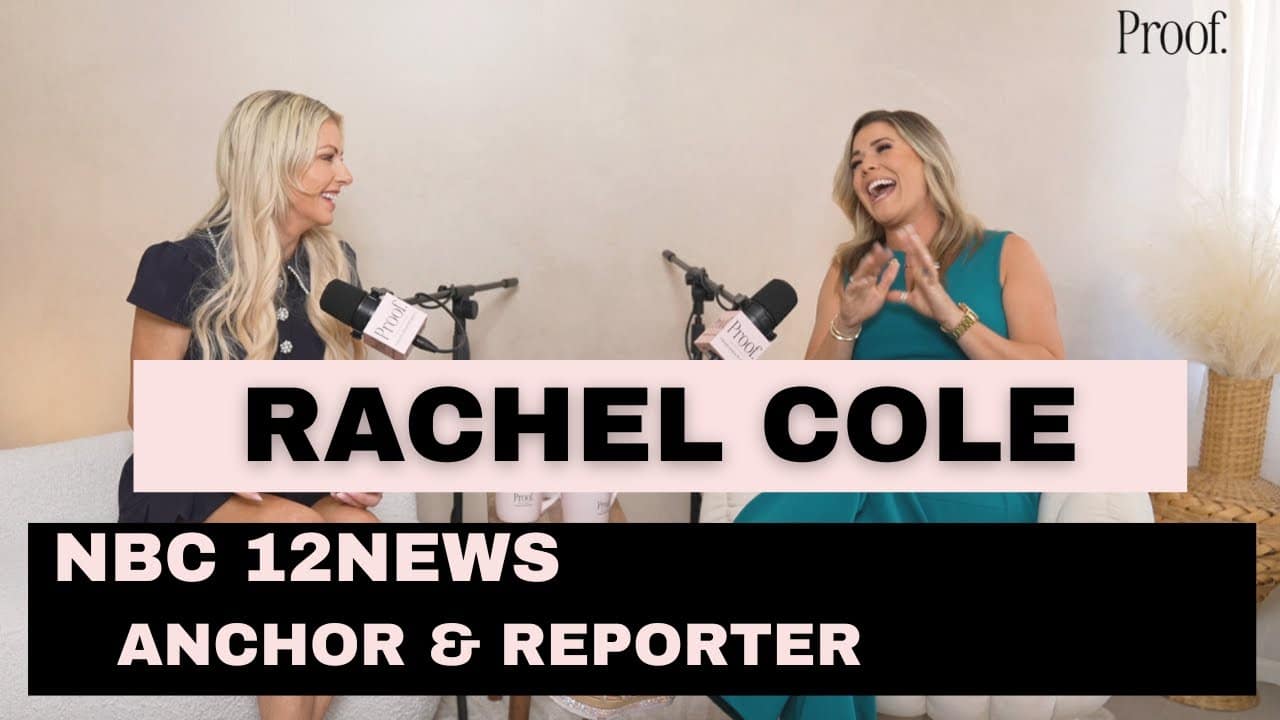
Who is Rachel Cole?
Rachel Cole is the host of Arizona Midday on 12News in Phoenix, a role she stepped into in October 2025 after eight years reporting and anchoring at the station. A native Arizonan and cum laude graduate of the Walter Cronkite School of Journalism at Arizona State University, Rachel Cole started as a writer for the Puma Press at Paradise Valley Community College, spent five years as a morning anchor and reporter at KRIS in Corpus Christi, Texas, where she covered the Hannah Overton trial, and came home to 12News. For the two years before this episode she was the station’s designated community reporter, working with nonprofits and families across the Valley.
In this Off Deadline conversation with Proof Publicity founder Melissa DiGianfilippo, Rachel Cole tells the story of a firefighter training simulation that triggered a real panic attack while her photographer kept rolling, and why two coworkers convinced her to let it air. She talks about the presidential candidate interview she was offered and then lost to a scheduling conflict, about imposter syndrome in an industry that tells everyone to fake it, and about covering the Super Bowl in Phoenix, including a Guy Fieri interview. She also describes an alleged child abuse case in west Phoenix that was hard to process and how the reporter and photographer relationship carries her through the worst days.
Rachel Cole makes the case that journalism is solution-based at its core, identifying problems so they can be fixed, and that public information officers and reporters share the same goal of getting information out on deadline. She explains her puzzle method for organizing a story, admits she hates chasing people down courthouse stairs for a comment, and remembers a young East Valley boy who sang the national anthem for the Diamondbacks as the kind of story that matters most to the people in it. Her parents, a Phoenix police officer and an airline employee, gave her the work ethic. Her strangest expense was a blacklight for a scorpion story.
What Rachel Cole said on Off Deadline
“I finally understand what a panic attack is.”
“There’s a difference between being on a show and being part of the show, and actually showing them, like, what, what it is that you experience first-hand.”
“I think journalism’s, like, the number one industry where people suggest faking it until you make it, and imposter syndrome is very prevalent in our industry.”
“I really pride myself on not putting on a front, um, not putting on a news anchor voice.”
“We really are identifying the problems, sharing what they are, and then really what journalism is at its core is solution-based.”
“And boy, if you don’t laugh at yourself in this business, you’re gonna have real problems.”
How do you pitch Arizona Midday and 12News? Proof’s take
Rachel Cole has since been promoted to host Arizona Midday, 12News’ midday lifestyle show, which makes this episode more useful, not less: it is a map of how the host thinks. Three things worth taking from this. First, she believes in showing the experience rather than narrating it, and she let her own panic attack air because coworkers told her that was the story. Pitch Arizona Midday segments she can do on camera, a demo, a tasting, a first-hand try, with a guest who can be honest about it. Second, she spent two years as a community reporter and still measures a story by what it means to the people in it. Nonprofits, families and locally owned businesses with a real moment to share fit her instincts. Third, she says PIOs and reporters want the same thing, information to the public on deadline, and she dislikes ambush interviews. Be the source who returns the call fast and wants to talk. Proof Publicity earns coverage for Arizona hospitality, healthcare and community clients on 12News and the other Phoenix stations, and Arizona Midday is a regular target for our lifestyle and food pitches.
Watch the full episode
Proof Publicity earns midday and lifestyle television coverage for Arizona restaurants, hotels and consumer brands. See our hospitality PR work.
Episode transcript
Read the full transcript
[0:21] Welcome to Off Deadline. I'm Melissa DiGianfilippo, and my guest today is Rachel Cole. Welcome, Rachel.
[0:21] Thank you so much for having me. I'm so excited. Love the name Off Deadline. Thank you.
[0:21] Rachel Cole is an anchor, reporter, and multi-skilled journalist for 12 News with 13 years of experience. She joined NBC 12 News from KRIS TV in Corpus Christi, Texas, where she was a morning anchor and reporter covering several high-profile trials, including the Hannah Overton case involving a foster mother who served seven years in prison before her conviction was overturned. A native Arizonian, she is a cum laude graduate of the Walter Cronkite School of Journalism and Mass Communication at Arizona State University. In her spare time, she enjoys running, hiking, and cheering on Arizona sports teams, and I know for a fact she has a really cute dog because I also have- I- … a really cute dog. Is it a full poodle?
[1:13] Oh my gosh, no. She is a mini Irish doodle. And I am obsessed. W- remind me of your dog's name. Molly. And she's a toy poodle.
[1:13] Oh my gosh. They, she's like the spitting image of Hera the dog. Literally. I- I love her … uh, we have to do a play date.
[1:13] I know. And we keep saying it, and now it's summer.
[1:26] And now we're busy girls. But we gotta make it happen. So, I am so happy to have you. I've known you for a couple years. I love working with you. My team loves working with you, and it's just gonna be fun to kinda go behind the scenes with you today.
[1:37] Yeah. Well, the feeling is completely mutual. I'm very excited to be here.
[1:37] Awesome. Okay, we're gonna jump right in. Okay? First thing I always wanna know is how did you get into broadcast, and why did you pick this career?
[1:37] You know what? It just occurred to me. I was going to bring a prop, and I totally forgot. It was a newspaper, The Puma Press. So Paradise Valley Community College, one of many amazing Maricopa County community colleges. Started as a writer, kind of got into creative print writing and print journalism, and then I had a professor just kinda say, "You'd be really great at broadcast. You should apply"- when it was time to apply at A- Arizona State, and said, "Okay, cool," and did and got accepted, and it all kind of snowballed from there.
[2:17] So it just started as basic print r- journalism, like at a-
[2:17] Just a love for the n- … community college.
[2:17] Yeah. Wow. And did you always have a love for the news, or like l- I, like, fact-finding, or was that just… Or was it writing?
[2:17] You know, it was more the writing. I was not a mathematician in the slightest, so I took to writing far, um, more than I did with anything else in school. And, you know, dear diary moments- back in the day and writing notes to friends in class. And, you know, I would love to say that I was five years old and there's a video of me reporting the weather, but there just isn't. It really grew when I was, um, in my 20s.
[2:40] That's awesome. And I- you said something that's interesting, 'cause it happened to me too. Sometimes you don't know what your skill's gonna be until someone points it out to you and is like, "You have a skill for this. You should go in this direction." And it sounds like a professor did that for you, and same thing happened for me in PR.
[2:57] Really? I was gonna be a magazine editor. That was my- I was going to school for magazine journalism, and a professor in a PR course was like, "I feel like you should try this." And when someone says that, I, I had no reason to think otherwise. Sure. I would go for it, you know?
[3:24] Yeah, you don't wanna negate that. You're like, "Hey, let me give it a shot." And so Judy Gailbraith, I will never forget her, she was the one who told me that. Again, a proud Puma turned Sun Devil, and just thank her for pointing that out and being so encouraging, 'cause they're so much more than just teachers. And she's a total, total mentor and guidance counselor. Yeah. I love to hear that. Well, thanks, Judy. Judy. Yes, Judy, thank you. We're diving in. We're gonna go deep. I wanna know what story pushed you the furthest outside your comfort zone, and how did that experience transform you and how you report?
[3:41] Oh my gosh, and it's so tough in the last 13 years, and it, it changes every single day, so I'm trying to think back. So I will say on any given day, you go into an editorial meeting, you don't really know what the day is going to bring, and I was assigned to go cover basically a, a simulation of what first responders do when responding to a house fire. In this case, it was a roof collapse. And because of the training facilities that local fire departments have, you're able to go and see what those simulations, what trainings are like. And so I had X amount of hours to get it done and turn it for the early evening shows. And so I thought, "Okay, cool. I'll go out and they'll show me what's going on." Well, managers and what we call producer vision wants the most visually compelling for the viewer to really understand. So fast-forward, I have the turnouts on, okay? The firefighters gear. The full gear. The full gear. Yep. The tank. I've, I'm having this, uh, firefighter assist me in putting it on, and then we are then asked to then go into what would be a house or a structure, and they're like, "We won't cover your eyes, but just close your eyes so that you understand you can't see. You can barely hear your crew, and you're just overwhelmed in the weight, too." So I made it maybe about three feet and started panicking. I started panicking. And I forgot that my eyes were closed. Like, I finally understand what a panic attack is. And so then, again, fast-forward to now I'm trying to write the story, and I was encouraged by my two current coworkers to share that experience because if we're trying to simulate and/or share with viewers what it's like to be a first responder- then just admit you can't. Right. You cannot do what they do. And so that was a very overwhelming thing to try to tell in story form, but I think the natural reaction that I had to it helped communicate to the viewers that we have no idea what our first responders go through, and to say that they are heroes is an incredible understatement.
[6:00] Wow. It was cool. It was pretty- And d- was the experience filmed for a segment, or was it something that you were doing to be able to describe?
[6:00] So it was filmed for a segment, and unfortunately it was on the heels of an actual fire and, and- situation that happened. Yeah. Um, thankfully nobody was hurt, but- It was crazy because my photographer, seasoned, you know, guy that he is, he kept rolling on this situation that I was going through. So you can see the distraught, like- just overwhelming, and it was so embarrassing, and I was like, "There's no way I'm going on the air." And again, uh, encouragement from one of my co- coworkers, two of them, who said, "You know, this is, this is part of storytelling, is what you experience, what you saw, being in an environment- whether it's good, bad, or ugly." So it was, it was very moving, and just put into perspective again how incredible our emergency crews are and, and what they go through, and being a daughter of a police officer, like, I can't imagine some of the things my dad went through over 30 years, and I, I don't envy him. Yeah. So even on my toughest days, like, someone's got it- bad. And the vulnerability that you're able to show viewers in moments like that when you were like, "This is never airing"- and then maybe you use it, is so important. I think when people have an emotional connection to you and they feel like you're being real, it is so different how they consume what you're saying. There's one thing, yeah, there's a difference between being on a show and being part of the show, and actually showing them, like, what, what it is that you experience first-hand. And reporting, I mean, you go and you're gonna stand somewhere, then, then bring me there as a viewer. Bring me in. So. Yep.
[7:25] I love that. Thank you for sharing that story. Yes. Yes. Every journalist that I've spoken to so far talks about some moments of doubt they've had in their career, 'cause it's not an easy job. We know this. Is there a time when you reached a professional crossroads, and how did you navigate that moment?
[7:44] That's a really great question, too. The, I wanna be asking the questions, Alyssa.
[7:44] I know. No, these are great questions.
[7:44] A crossroads in my career, clearly, I think journalism's, like, the number one industry where people suggest faking it until you make it, and imposter syndrome is very prevalent in our industry. Uh, but more recently, I had the opportunity through a string of coincidences or whatever it was-507 something. To, yeah, exactly, to have the opportunity to interview, uh, a po- a politician who was running for President of the United States. Wow. Pretty elite position- regardless of where you stand, and a get, as we call it in the business. And so I kinda thought to myself, "Well, I'm, I'm not a political reporter. I don't, I don't have any, like, background in politics." I kinda just scratch the surface when necessary on a day turn." And so I didn't think that I- Was qualified … would ever be prepared or qualified. And there was so much self-doubt, and thankfully, I have an amazing husband who literally has my back, and there's nothing I can't do in his eyes. And so of course, I ran through a couple of scenarios with him, and what, tried to simulate what, uh, an interview would be like with this politician. And, um, again, had great managers in my corner who were like, "No," like, "let's just pick a couple of things. Let's focus. Let's find the path where you're comfortable and ready." And unfortunately, I didn't get the opportunity. There was a scheduling conflict. Yeah. But by the time it was all said and done and I had confided in the people who, who know me personally and professionally, I, I did feel ready.
[9:39] Wow. But boy, I mean. What a moment.
[9:39] Yes. But to fake it till you make it, I'm like, "Well, why not me?" Instead of asking, "Why me?" "Well, how about why not me?" And you're right, it doesn't take, maybe you assume it has to be someone who's only on that beat, and who is very well-versed- and you think, like, that's what viewers expect. But also, you're a human who gets to vote for the president, and you happen to be a news anchor. Right. Um, so why not you? Yes. You know? And I was so excited. I'll tell you, that day, I mean, I had butterflies and, and, and anxious feelings and all kinds of stuff, but I felt prepared and I felt ready, and I was so disappointed to, to have missed the opportunity. But then I thought, "Okay, the answer's not no, it's not right now." And next time you'll do it. And next time. And next time I'll be all the more ready, yes.
[10:20] Yes. Yeah. That takes, and I imagine, you grew up here. And I've talked to a few other reporters who've grown up in the Valley. Maybe there's things that feel extra hard about knowing your community that you've grown up with is watching you on the news, or maybe it makes it extra easy. I, have you, how do you deal with that feeling of, you know, I'm growing up here and people know you, you know?
[10:34] That's actually a good question, too. I, um, I don't think about it too much. You know, your big goal when you start in this industry is to make sure you can get back home to your home market. I love being here in Phoenix. I did grow up here. I only had to spend five years away cutting my teeth, and it is funny to think about if you hear from someone maybe from high school who snaps a screenshot and they're like, "Oh my gosh, there's Rachel." "I see you on the news." Yeah. Yeah. And, and it's fun. I don't think it adds any pressure, because they know me, and I like to think that who they knew, you know, back in high school is exactly who they're getting on the TV. I, I really pride myself on not putting on a front, um, not putting on a news anchor voice. I mean, you wanna be professional, but- I like to think I'm past that point of, of pretending that I'm the news anchor or the news reporter, because I am that. Yeah. And for almost 15 years, it's- it's been great. Yes. Yeah.
[11:35] That's awesome. I love that. It's, I mean, a great reminder just to, like, not let those things hold people back-
[11:35] Yes … that, that could, you know? Exactly. Yes. No, and overthink- who's watching. Yeah, exactly. Hi, Mom.
[11:51] What is the most joyful or uplifting experience you've had while working so far that reminds you, like, "Yes, this is, I'm doing what I love every day"?
[11:51] Oh, gosh. In the past two years, I was more designated as a community reporter, getting to work with a lot of non-profits, getting to do a lot of community live shots, and interact with families, and just- … philanthropists, and I, I really took a lot of pride in that role because of growing up here. And, you know, I think there's, there's so much sh- strength and benefit to the viewer to educate them on everything that's going on in, in our own backyard, so to speak. And so the greatest joy is legitimately meeting new people, finding out what's important to them, and, you know, really just touting Arizona as a whole. And it's, it's just, it's so fun for me to hear a producer in my ear saying, "Okay, and we're coming to Rachel in three, two, one." And it's like, let's go and let's make this fun for whoever I'm interviewing, whether it's a, a little kid or, uh, you know, a group organizer or a founder. It's just, they're all just so joyful. And of course, the really, really fun stuff that's obvious is, like, covering the Super Bowl and interviewing Guy Fieri and his sons and, and talking about…
[13:16] I don't like when people do that-
[13:16] … when I interview them. And just, and talking about everything that's fun and good about a grandiose event that brings so many people together, and it's just, there's, there's so much joy to be had within our community. And so anytime I get the chance to do that, it's gonna be top, the top of my list of- a- awesome moments.
[13:36] That's cool. Is there one that, like, stands out that you're like, "Oh my God, I can't believe I'm here"? Is it the Super Bowl, or is there something like that that you just were amazed that you got that opportunity to go somewhere or, you know?
[13:57] So yes, um, prior to the pandemic, there were often opportunities for reporters specifically affiliated with a network like CBS- NBC to go and do what is called a press junket. And so you get to go and meet the actors and actresses who are starring in new drama series- or new sitcoms and things of that nature. So I was asked to go to LA and New York, um, and it had been a minute since I'd been to either place. And so it was so fun to go there. You get to go with a photographer. You're traveling for work. You get a per diem, which is fun. You're like- … "Yes, lunch is on the house." And that's a big deal. Ask any journalist. If free food is available, they're there. Um- Exactly. Oh gosh, yeah. We're all like, we're never hungry until food's around, and we're like, "Oh my gosh, what is it? Donuts? Pizza? We're in." And so that was a really incredible opportunity. I got to meet other reporters from different, um, markets and, you know, shoot the breeze with them. Obviously meeting actors is really fun, and then to see those shows go somewhere into- maybe another season, like Off Deadline- or something of that nature was really cool and just felt very, you know, elite. You're standing on the- red carpet interviewing people from AGT, America's Got Talent, and that was fun. And Julianne Hough was there. Like, it was fun. It was so fun.
[15:15] I would love that. Terry Crews.
[15:15] Yeah. Yeah, it was just, it was fun.
[15:15] That's cool. I, I love that. Yeah. I, like, the entertainment side of it would be really fun, I think.
[15:15] Yes, it was a different, different than the day-to-day.
[15:15] Yeah, absolutely. So. A nice break. Can you share an instance where you witnessed something in the field that was difficult to process emotionally? And just talk about that experience and how you handled it.
[15:26] You know, they use the term jaded so often for people in our business, and it's sad that I couldn't tell you something so specific so quickly because-
[15:26] 'Cause you've clearly seen a lot …
[15:46] we, we see it all the time. A- and people wonder, you know, how can you possibly try to interview someone on their worst day? And it's like, in this day and age, when you have an opportunity to speak to a family member about a tragedy or someone impacted by something negative, you're, you are genuinely trying to help them. It's not to just cross something off the list. And so, you know, if we show up to house fires and you see a family displaced or neighbors who are trying to help before f- first responders got there, um, I think those just kind of sit with you a little bit longer than day-to-day news, and your heart just hurts for them because there's only so much you can do. But if there's an opportunity to get the community involved to help or to promote the GoFundMe that might help them- just a little bit. Um, so unfortunately there's, I feel like there's too many that I f- feel like I've covered, and I'm grateful that in recent days and weeks and months I haven't had to cover as much of that. The difficult one to process that sticks out is we headed to West Phoenix and there was allegations of child abuse. And there was an alley behind this neighborhood, and there was still kind of what looked to me like evidence from the situation, and it's hard to see that. And, you know, it, it's mind-blowing that I can't just tell you, "Yeah, you know, when you see them cover a body or something," that that's not the one. But when it comes to children involved in some of these, these tough news stories, that is the hardest. I, I don't have kids of my own, but I have 10 nieces and nephews, and it's, it's too much to even fathom what families go through, whether it's a drowning or, in this case, something worse where it's intentional and, and you're harming a child or an animal. I mean, the animal cruelty stories. Oh, God. So this particular one, it was just, there was a few toys, you know, baby dolls and stuff scattered, and then there's, you know, you, you see, like, a plastic bin. And then you just- Oh, God … you just start thinking about all of the other stories. And my, my auntie is a paralegal, and so she has to read these stories, you know, that are even more detailed than any newscaster could ever imagine because it's police taking the reports, and it's information that gets redacted. And so those are incredibly challenging situations to be at, and that one in particular was just- Even if it wasn't related to the case, the, the stuff that was around the scene where we were doing live reports was just too much. And you have PIOs, but, public information officers, with Phoenix Police telling us, "If for some reason you can't take care of a child or you don't want a baby that comes into your life, just drop it off at the safe haven places." Like, the fire departments will take it. The, these non-profits will take it, no questions asked. So- Yeah … that is- That's- … disgusting- … heart-wrenching … and it's heart-wrenching and it's heartbreaking. And I know you can't save them all, whether it's animals or kids or whatever, but you just, you just wish there was something else that you could share with the community that let them know that's not their only option.
[19:16] Yeah. There are other options before something like that happens. Yeah. So that's, those are tough. Though I can't even imagine. Those are tough. And I just, like, I wanna say thank you for, like, doing the hard work, 'cause I think as viewers sometimes we're like, "No more bad news." But if we don't know, uh, or, about the, we, there, justice has to be done, ha- given- Yeah …
[19:37] had. Yeah. And we need to know. And so, like, that bad stuff is critical. Like, it was someone's kid. Exactly. I understand a lot of people think that it's all bad news. We're not trying to just point out problems and then say, "Okay, have a great day." We really are identifying the problems, sharing what they are, and then really what journalism is at its core is solution-based. Like, but we can't find a solution if we don't identify a problem. And so- Yeah … I think we wanna work in conjunction, and police departments have said, you know, "How can we better serve the media?" And I've just shared with a couple close friends in police departments that, you know, the reason why we nag you via email and try to get information about a scene or a developing situation is because we both have a shared goal, and that's to get information to the public. The difference is we have to do it on a deadline, and so that's why we bark up your tree about, "What can you share? Is there a vehicle description? Is there a suspect description? Is there harm to the community? Is there a threat to the community?" So they have been doing such good work in improving their public information and getting us those answers, and sometimes there aren't any. Yeah. But if we don't ask, then we're not doing our job. So there's a mutual respect that's really growing between public information officers and the media, and I wanna see that relationship continue to grow because, again, the shared goal is to get information to the public.
[20:50] Yeah. You said there's a bunch. Yeah. And I have no doubt that that's the case. In any of those moments, how do you deal with that when you go home at night and you have to kinda turn it off? I imagine it's hard. Like, you ha- you've gotten used to it, but, like, do you have coping mechanisms? Do you, how do you deal with that, like, mental health toll that it probably takes?
[21:27] That's a good question, too. I think part of it is, again, who you have at home and, and their, you know, ear that you can bend and kind of talk about it with. Um, a lot of venting and getting that off your chest or processing it is also with your photographers. Like, the photographer-reporter relationship, while it's weaning just a bit because of, you know, MMJs and multi-skilled journalists and things of that nature, that relationship is pretty powerful because you both understand that you have a job to do, but then you can talk about it on the drive back to the station or in between breaks of shows and things like that. So I'm thankful to have worked with so many great photographers who have been in the business far longer than even I have, who know when to keep it light and when to listen or when to give a different example of something similar or, you know, or worse, unfortunately. And so there's a pretty powerful relationship there where you feel like you don't necessarily have to take it home. It's almost like therapy right there just getting it out and talking about it. And I mean, especially on those longer commutes to get to a scene or if you're going to cover a storm in Flagstaff, I mean, you learn so much about somebody in just those, those little drive times, you know, when typically, uh, you know, we're all alone or we're listening to a podcast or the music or, you know, you, you take that, take advantage of that. And somebody who was right there with you.
[22:49] That's great. Yeah. Which of your stories do you believe made a genuine difference despite limited public attention, or maybe it was all more behind the scenes that what you did made a really big impact?
[23:09] I would have to go back a couple of years. I think it was pre-pandemic. But there was, um, a young boy in the East Valley, and I'm drawing a blank on his name, but he was really excited and genuinely wanted to do and perform the national anthem for the Diamondbacks, and that's a big deal. Yeah. I feel like if I ever get to throw out a first pitch, I'll have made it. You know, everybody has something different, like if I'm a bobblehead or if I become a Barbie doll, like, in real life. You know, something like… But first pitch is a big deal and performing the national anthem even more so. And so we went and did a feature on him. Yeah. And of course you tag everybody involved and all organizations, and you hope that something like that goes viral. And in this case, it didn't necessarily go viral, but he then got an invitation to come and do it. And I just, I'm not, I'm not sure if we hadn't done the story or if just, you know, his mom touting it on Facebook would've been enough, but it was so great to see this little boy's, like, wish or dream to- Yeah … to do this performance and our nation's anthem, and to do it in front of such a big crowd is just so cool. And again, I don't think it caught a lot of fire on my social media pages, but in general, just airing it, and I feel like a lot of times, you know, our team will get to tell the viewers, you know, "Because of a story we did right here on 12 News, this happened or that happened and change has been made." Obviously, a lot of that is impacted by the I-Team and their investigations. But- I, again, the last two years where I've been the community reporter, I don't know that all of that got a lot of, you know, accolades and applause, but I know that the people who were involved in the stories felt like it was the biggest deal, and I was happy to be a part of it, and to roll my gear out, and shoot it, and tell it, and find a song to lay under it, and that all is a big-
[24:38] Oh, yeah. That all is so amazing to me that they get… They gonna have that 90-second package forever. For e- And I think like as a PR person, it's so true that sometimes one story, like whether it's a kid getting his dream to throw a first pitch or a business getting a line out the door, or- Yes … someone telling important tips and tricks to, like, keep your kids safe, it doesn't matter. One story can make the biggest difference. Um, and I, I think people don't always understand that. Yeah.
[25:28] Like it, it can really change the game. And to be honest, when we're sitting here talking about post-production of even this conversation, and how it looks, and how it comes off, and how it's viewed, every day, five days a week for 13 years, I've been able to take, you know, eight hours worth of work and condense it down into 90 seconds. And again, to the people involved, that's all they want. I interviewed a little boy… Oh my gosh, this is so great. Yes. A little boy at the Diamondbacks game a couple of weeks ago, and his mom, I said, "Here's my phone number. Please text me if you can't find the content or something." 'Cause, you know, streaming, YouTube, and Twitter. So much. Yeah. Like, I don't know where it lands. I said, "Please just text me and say, 'Hey, can you please get me the clip?'" And she is so over the moon. You changed her night. How, how long did that take me? Nothing. Yeah. The work was already done, like she just couldn't find it, so. Oh, that's so nice. So fun. That's a great feeling. He was such a cute little kid. Aw. Ugh. The kids. I love it.
[26:22] What aspect of your personal background shapes your reporting in ways that the audience might not recognize?
[26:50] I would say a big part of, of who I am as a young lady, as a young journalist. Um, is, is a huge, huge credit to my parents. Very independent, like hardworking. My mom has been with the airlines for almost 30 years. My dad was 30 years Phoenix PD. And they just hustle, they just work, and they set good examples to myself and my three siblings. Um, and I just… As, as much as we like to laugh and joke and be sarcastic and feel like us siblings for sure have our own language, we just… Hard work and discipline and showing up and being on time. Like, if you, if you're a police officer and you show up late to, to debriefing, phew, I don't wanna know who your sergeant is, 'cause you're gonna be read the right act- … just like a criminal would. Then you got my mother, who, again, has been working for the airlines for 30 years. Wow. If you show up late, guess what? I think it, we all know as passengers- We all know what that looks like … they don't wait for you. Yeah. And, and you don't get a lot of chances. And so I think from, for me personally, to have deadlines be part of my day-to-day is no accident. I'm just accustomed to, you know, being on time, being strategic, making sure that I can get everything done in a timely fashion, and I just, I think my parents and my siblings are very much to thank for that. Family is, uh, is very important to me, which is why I tried as fast as I could to go from South Texas back here home to Phoenix, and I missed them real bad, but- Oh … it, it was worth it. Um, my mom's side of the family wasn't too far away in Austin, Texas. Yeah. But just, yeah. And even extended family, I mean, they just hustle. There's, there's property managers and real estate agents, and everybody just is looking to serve someone else. Mm-hmm. And so when I, you know, take my gear and start reporting for the day, uh, the, the idea is to either serve the audience with information and to, to help their lives in one way or another, or to help the actual, you know, person or, or group I'm doing a story with that day.
[28:59] Yeah. So. It's… I love that it's your family who, like, ga- taught you some of those really critical core values that make you so good at your job, and I'm sure have helped you grow. Mm-hmm. And, you know, there's a lot of peers of yours, I'm sure, who just didn't get as far as fast, and it's because you are on time, and you show up prepared, and you're, like, ready to put in the work.
[29:19] My dad's favorite story is, you know, there's, there's these personalities that match with colors, and they're all a little bit different, but his favorite is to say, "Well, Rachel's my gold." You can't tell her, "Hey, this starts at this time," because if it's that time, she's gonna be standing outside by the Astro van waiting to go to California in the middle of summer 1996 saying- … "We're supposed to leave right now." So they finally just stopped telling me when we were gonna be leaving, 'cause-
[29:39] I love it … boy, I'd get hell bent if I'm not on time. You're like, "You told me this time."
[29:39] Exactly. And so, yes, which is also why I was here 15 minutes early.
[29:39] I love it. That's m- You're my kind of girl.
[29:54] I am like, on time is early. Like, yeah. It, it- I mean, period.
[29:54] Right. Exactly. So I appreciate it. Couldn't agree more. Yeah. That's wonderful. Yeah. Um, okay, we're going into rapid fire questions. Okay? So your job is to say, like, the first thing that comes to mind. Please tell a little story. Tell a little story if you need to. Okay. Okay. Secret weapon to get you through a rough deadline day.
[30:11] Oh, gosh. I'm supposed to answer these quickly? Secret weapon would be to just gather as much information as possible. Like, think of a puzzle. You dump the puzzle out on the table, and you wanna flip the pieces over and just try to organize them as quickly as possible. So what information do I have? How can I organize it and start skeletoning my package, story?
[30:28] Nice. I like that. Yeah. I haven't heard someone ever use that, like, a description.
[30:28] Oh, yeah. It's really smart. You need a puzzle at the end of the day. Where are my pieces? And then what's the hardest ones to get? That's the ones I need to prioritize.
[30:45] Yeah. Yeah. Awesome. Most bizarre place you've ever conducted an interview?
[30:45] Oh, gosh. You're usually in hallways, or you're trapping someone probably halfway down the stairs in front of a courthouse, chasing someone down. "Did you commit that crime?" I just think the, the most awkward interviews are the ones where you're chasing someone down. Like, you know- "Please talk to me" … you know how ridiculous it sounds. You know how they're not going to respond to you. And so that's probably just the awkward interview versus an awkward interview place. But-
[31:03] Yeah … I, yeah, I don't love those. That's, like, not my bread and butter, to chase someone down.
[31:03] No. I like a very designated-
[31:03] Like a planned interview …
[31:20] They wanna talk to you. We know what's happening.
[31:20] Right. They want to be involved.
[31:20] Yeah. Yeah, yeah. That's, that's better.
[31:20] One interview subject you're secretly hoping to land?
[31:20] Okay, so that's the same. I would like to interview the President of the United States. Yeah. I don't care which one it is. I mean, there's been so few to hold that position. I think that would be such a cool interview. Obviously, I think we all have a lot of questions. Um, but outside of a serious politician, that sounds like an oxymoron. Um, outside of a pol- uh, I would probably like to interview Robin Meade, also someone in the business. Yeah. Where, how she got started in her career, and where, where she is now after HLN kind of went sideways. Yeah. So.
[32:02] Oh, that's a great, that'd be a great interview.
[32:02] Yeah. She's just so spectacular. I, I just love her anyways as a viewer, but it would be great to talk one-on-one with her about her journey and what- what she's doing now, and-
[32:02] On that note, real quick, I have to ask a question about, like, long-term goals as a reporter. Is it always a dream to go do national, or is local really the place where people strive to stay?
[32:20] When you start in any career or industry, you have this idea of what your dream is. I think that every five to 10 years, or call it what you want, you should revisit what you think your dream is, because I'm sure a lot of people do dream that big. "Oh, I wanna sit on the Today Show desk. I want to be a traveling reporter." I've given those things a lot of thought, and first of all, that's, that's an even greater hustle than getting back to your home market. But is that my dream? And I think the more I think about network reporters, they are so amazing at what they do, but they are on the scene of every horrible thing that happens in our country, across the world, and I just, my heart can only take so much. And as jaded as I'd like to think I am, there's just, there's some things that it's okay to not be a witness to. And so to be in my home market with my husband and my puppy and my whole family up the road is, like, better than any dream I think I've ever had for my career.
[33:20] Oh, I love that.
[33:21] I'm, yes, I feel very blessed to have worked up to this point and earned this, this spot. Yeah.
[33:21] Most embarrassing autocorrect fail in a story- … that, or a post or whatever, that you couldn't take back, and you still, like, cringed a little bit.
[33:21] So have you ever swam in the ocean in Utah? Oh, the Salt La- like, wait. No. But there is a la- Wait, swam in the ocean in Utah?
[34:04] I missed that. Did you say that on air? I missed it, too. We were going to break, and bless her heart, I won't call her out, but she w- my producer was so distracted. She was getting ready for a very exciting concert for New Kids on the Block.
[34:05] I mean, duh. And so she- So she was distracted, and frankly, so was I. But this is a real Ron Burgundy moment. So I'm like, "And after the break on 12 News at 1:00, houses sliding into the ocean in Utah. We'll be right back." And then we go to break, and I'm like, "Did I just say that there are oceans in Utah?" And she goes, "My bad." And she's like, "I, I-"
[34:05] It was, like, on the teleprompter?
[34:06] W- yes. Oh, God. But it's like, it's not her fault.
[34:06] No, of course not. And you said it, so I mean.
[34:06] And I said it, and I'm like, "Oh, my gosh." I'm like, "I know that Utah is landlocked. This is so embarrassing." And then I think I made a joke about it, because you have, you have two deci- you have a decision to make when you do something like that. You can either hope that no one saw it, and everyone's watching their TV on mute, which is not good. Or you can basically point it out again and make fun of yourself. And boy, if you don't laugh at yourself in this business, you're gonna have real problems.
[35:05] Yeah, I can imagine.
[35:05] So I laugh a lot.
[35:05] Hey, that's gotta be the best way to deal.
[35:24] Yeah. And just to be able to go home being like, "You know what? Whatever happens today or tomorrow, like, I can handle it." And yes, sorry, Utah. I know you don't have oceanfront property. Neither do we. Let's just keep it that way.
[35:24] It's all on the record now. Perfect. Uh, weirdest thing you've ever expensed for the job?
[35:43] What have we expensed? I know one time I thought about buying an umbrella, 'cause, you know, we just, it doesn't rain. What's the weirdest thing I've ever expensed? You know what? It was a blacklight because we were doing a scorpion story. And so of course, for the 10:00 PM, we were trying to, it's brilliant, trying to find scorpions. So we expensed the blacklight. Because we're like, "Well, we gotta be able to find them." We did not find any, thank goodness.
[36:04] Well, I imagine, like, even with, like, your camera lights, it would throw off the blacklight situation.
[36:04] Yeah, yeah. You know?
[36:04] Well, you just kinda gotta find one, then okay, they're over here.
[36:04] That's so funny. Yeah, Mike at Pest Control doesn't really think that's smart maybe. Thanks, Mike.
[36:18] So yes, blacklight. And it's better to elaborate on why you bought a blacklight.
[36:18] Yeah, I know, right? Like- Thankfully it wasn't anything- The other story would be, like, going into a hotel room and- Yeah … doing, like, a cleanliness.
[36:18] Oh, like our, um, oh gosh, what did we used to do?
[36:19] The filth finder. Oh, God. Will Pitts always did the filth finder. So gross. Thank God. I would not ever- Never him … want to see I don't wanna know. No. No, bad. I don't wanna know. So bad, so bad.
[36:19] I really appreciate you sharing that. Yeah. It was such a pleasure to have you here today, Rachel. Thank you.
[36:50] Thank you so much. I'm so excited. I can't wait to see it. I, I gotta go to Chase Field and talk about baseball, I guess. That's gonna be fun.
[36:50] Every day is different.
[36:50] Yes. Every day is different. Um, so we're excited. The D-Backs take it on the Marlins this weekend. I know that'll be David.
[37:07] That's okay, though. But yeah. Yeah.
[37:07] The D-Backs hopefully pulling through, we'll say that. They're sick.
[37:07] I know. I, I hope so, too. Yeah. For all of us.
[37:07] Well, thank you for having me.