
Sam Eifling, Voice Media Group National Editor and Former Phoenix New Times Editor in Chief, on Chasing the Stories Other Reporters Missed
Sam Eifling was promoted in July 2026 to national editor of Voice Media Group, the parent company of Phoenix New Times, after running the New Times as editor in chief from January 2025 to June 2026. Beat when recorded: Phoenix news, culture, food and long-form features.
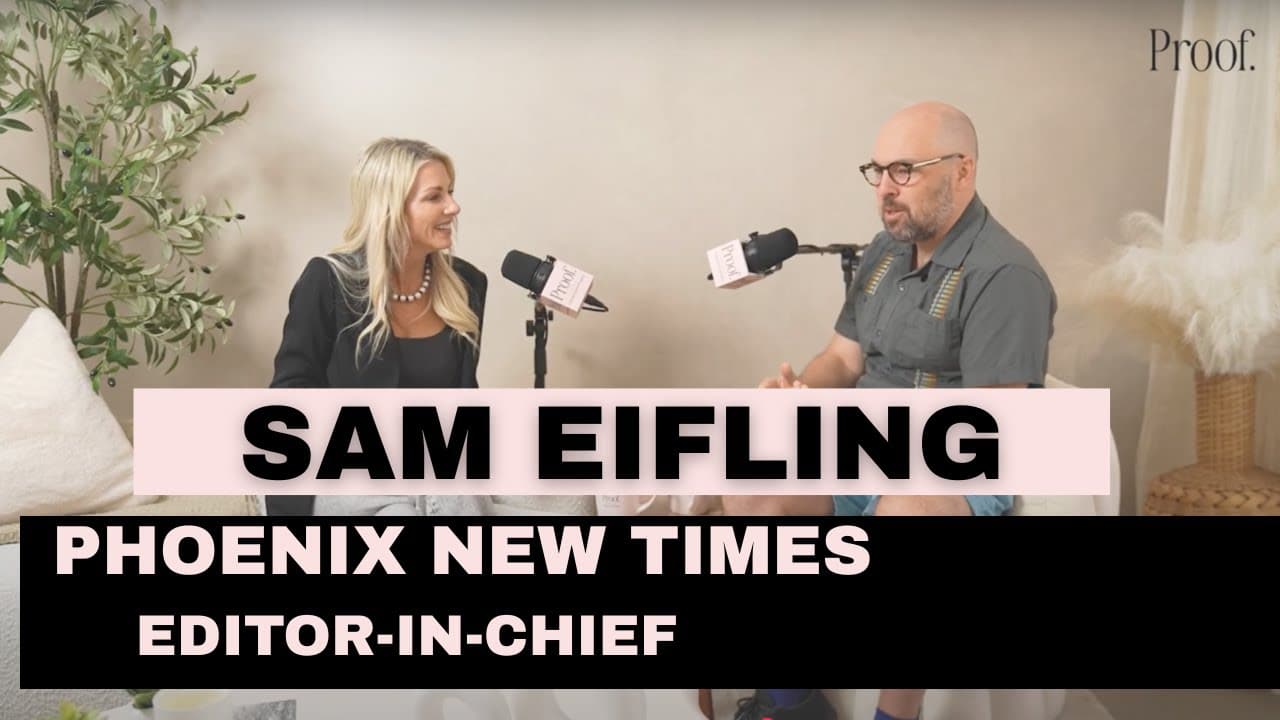
Who is Sam Eifling?
Sam Eifling led Phoenix New Times as editor in chief from January 2025 until June 2026, when he became national editor of the paper’s parent company, Voice Media Group. This episode was recorded during his first year running the New Times. Sam Eifling grew up in northwest Arkansas, the son of two English majors, studied at Northwestern’s Medill School of Journalism and earned a master’s from the University of British Columbia. He was a staff writer at New Times Broward-Palm Beach from 2003 to 2006, then reported and produced for ESPN, Harper’s, The New York Times, the CBC, Sports Illustrated, the Associated Press and Netflix’s Patriot Act with Hasan Minhaj, and in 2024 released the audio documentary Hold Fast: The Unadulterated Story of the World’s Most Scandalous Website with two fellow New Times alums.
In this Off Deadline conversation with Proof Publicity founder Melissa DiGianfilippo, Sam Eifling tells the story behind his biggest hit: covering the Hawaii legislature for the Associated Press, he took a source to coffee and learned that state law exempted on-duty police officers from prostitution statutes. Honolulu police testified to keep the exemption, his story went national, The Onion and The Colbert Report picked it up, and the law changed. The source later told him she had taken the same tip to several reporters and none of them saw the story. He also recounts the Sports Illustrated feature riding thousands of miles with pro rodeo cowboys, and the Alberta oil patch story that died when his editor at Slate was laid off.
Sam Eifling agrees with Melissa that pitching a journalist works a lot like online dating: one email is table stakes, and tenacity is how a serious pitch rises above the clamor. He is frank about an industry where many of the places on his resume no longer exist, why he values strong institutions more than he used to, and why he tells every young journalist the same thing: learn to write, because in every corner of media he has worked in, the best writers end up in charge.
What Sam Eifling said on Off Deadline
“I think that tenacity to rise above the clamor of garbage is, is part of the message, which is like, no, I’m serious. I’m actually serious about this.”
“Most of what you do in reporting, it’s you just like dropping a rock down a well and hoping you hear something back.”
“Find someone who knows what’s going on, take them to Starbucks”
“I’ve taken that tip to several reporters and none of them saw the story in it.”
“If you’ve seen it, 100 other people have seen it, and if no one’s done it, do it.”
“There has been no corner of any media that I’ve been in, which is a lot at this point, in which the best writers are not the people who are actually kind of in charge.”
How do you pitch Phoenix New Times? Proof’s take
Since this episode was recorded, Sam Eifling has moved up to national editor of Voice Media Group, so the instincts he describes here now shape coverage across the company’s papers, not just Phoenix New Times. Three things worth taking from this. First, Sam Eifling’s best story came from a tip that several other reporters had already passed on. The angle was there; he was the one who saw the power imbalance in it. A pitch to an alt-weekly like Phoenix New Times has to lead with the tension, the stakes or the absurdity, not the announcement, because that is what its editors are trained to see. Second, he said the quiet part out loud: one email is table stakes. A follow-up with something new, a better angle, a real person, a document, is not pestering, it is how a serious pitch proves it is serious. Third, he wants writing that arrests a reader who is scrolling, which means scenes, specifics and a human at the center. Restaurants, bars, hotels and cultural venues that can offer a reporter access, a character and a story rather than a menu are the ones New Times covers. Proof Publicity earns that kind of hospitality and lifestyle coverage for Arizona clients.
Watch the full episode
Proof Publicity earns culture, food and lifestyle coverage for Arizona restaurants, hotels and hospitality brands. See our hospitality PR work.
Episode transcript
Read the full transcript
[0:00] Welcome to Off Deadline. I'm Melissa DiGianfilippo, and my guest today is Sam Eifling. He is the editor in chief of the Phoenix New Times. Welcome, Sam.
[0:00] Hi. Welcome. I just said that you're great, I love it. It's sort of like when somebody says, you know, how how are you today? And and you're like, or like when they say, like, at the airport, they're like, have a good trip. And you're like, you two and you're they're like working there. You're like, you're not having like, what's going on? You're like good. Yeah. No, no, I get it.
[0:43] Sam has over 20 years of experience as a journalist and has been the editor in chief of Phoenix New Times since January of 2025. From 2003 to 2006, he worked as a staff writer for New Times Broward Palm Beach, where his stories won state and national awards. He then reported and produced for outlets including ESPN, Harper's Magazine, The New York Times, the CBC, Sports Illustrated, the Associated Press, and the Netflix show Patriot Act with Hasan Minhaj. In 2024, he and two fellow new time alums released Hold Fast The Unadulterated Story of the World's Most Scandalous Website, an audio documentary. He has a bachelor's in journalism from Northwestern University and a master's in journalism from the University of British Columbia. I am so excited to have you here today.
[1:33] Oh, thanks. Thanks for taking me. Excited to be here. Thanks for getting me out of bed.
[1:33] Oh, of course. I mean, it's a Friday. We're ready. I'm sorry. It's not vodka in the coffee mug, but you know somebody? One of y'all will have to be fired.
[1:33] Thank you. I don't want to overstep. No problem. I. I actually am a pro at firing people, so I know, I know the so long story for another day.
[1:48] Okay? We're going to jump right in. We're going deep today. Yes. Are you ready? So I want to first know why journalism. And how did you decide and how did you get your first big break?
[2:06] Oh, gosh. I'm still waiting for my big break. But so I grew up in northwest Arkansas. I always my both my parents were English majors. We always had books in the house. We had a few magazine subscriptions, and I had always thought of writing. Writing was something I was good at. I was good at school, is good at tests, and went to a nice college. But it didn't seem like a job, right? It seemed like the kind of thing like, oh, somebody somewhere else gets to write for a living. And we had a newspaper in town, but it wasn't all that great. Okay. But when I got to northwestern as an undeclared student, I started reading the student paper, which was the best student paper by some o First Nations in the country. And I was like, I could do this shit. Like, this is really. But it was I was a big fan of Sports Illustrated at the time. I read Rick Riley's column. Yeah, he was a longtime LA times sports columnist who went to Sports Illustrated, and they gave him the back page of the magazine. So every week you read the rest of the articles and then you get to the back. And Rick Riley is like riffing. He's funny, he's got pathos. It's like, man, this is like really the ideal. And I would take Rick Riley columns and tape them to the inside of the bathroom stall in my dorm. Right. So it was like, if you're anybody that was going to be on that floor, if you were in the stall, you're going to be reading my versions of, like, Rick Riley's greatest hits anyway. So I decided, like, I'm going to go for it. I'm going to declare my major is journalism, which was tough. I actually had to switch colleges within the university. And Medill, which is that school, was very selective. And so like to get in was hard, but but it was a good fit. From the time I was doing it, it just felt like it was a lot of stuff I was good at. But it's also extremely challenging, and it remains extremely challenging because, yeah, I think especially for me, being a kid from kind of a small town thrust into the big city in school, I had a lot to learn about how the world worked. And that's what journalism forces you to figure out every day, and not just, you know, how does how do the markets work or how does an election work or how does the NFL work? It's kind of just how do people get along? Like how how do you get anything done? And how do you reach out to the right people in the right way to get the information that you need to pair with this other information? All of that was a huge, learning curve and remains that I would say, because the world keeps changing. Yeah, no matter how perfect I am. Like other things around. Amazing, right? I don't know, like, people keep changing the rules of this. And I think especially coming back to a print publication, I mean, we have a print product where we're primarily digital, coming back to that, after years of not being in digital media or print, I'm relearning the new rules again for this stuff, but I think there was some bedrock capability and bedrock skills and bedrock values that have really served me well, that I try to bring to the staff and bring to what we do. So yeah, so it does feel like a continuing education all the time in this business.
[4:58] Yeah, it 100% is. It's changed. I've been in PR for 20 years and the way I started, you know, pitching media or working with clients is dramatically different than what it looks like today. And so, so I mean, we weren't really sending all emails when I first started that was like that. It was it was happening, but it wasn't all that was happening. And, it's now like if I send an email, honestly, it's not always the way a journalist even wants to receive information today because they're so inundated. So sometimes I'm texting them or I'm Instagramming, messaging them, or it's just there's so many communication channels when, you know, 20 years ago there were like two journalism is basically dating.
[5:45] It's totally dating. Uganda online dating. You guys are like, I'm going to shoot my shot here and here and here and here. And then you get the restraining order and you can't do that anymore, but you just move on to the next, victim client potential mate. It's fine. Are you are
[5:45] I love it. I love that analogy.
[6:01] I might just I mean, if anybody's dated online, you know, it's like, well, okay, they didn't respond here, but does that mean anything? Does it mean anything that somebody didn't reply it to something? Not really. Not necessarily. And and you do have to be creative. And I'd say having worked in broadcast, I've worked in radio and TV, what you're describing is just chase, right? It's just good chase. It's like, yeah, we want to talk to this person. We want to get this person on the air. You could just write them an email, but if your boss later is like, how's that going? You'd be like, I sent him an email. And he would be like, I don't care. What are you what else are you doing like that doesn't that is the first step. That's table stakes. Like you have to keep going. So I think that tenacity to rise above the clamor of garbage is, is part of the message, which is like, no, I'm serious. I'm actually serious about this.
[6:37] Yeah. Can we actually do this?
[6:37] And I think at a certain point people do respond to that.
[6:37] Yeah. Oh for sure. Absolutely. Can you share a moment when you witnessed your journalism make a tangible, positive difference in someone's life?
[6:55] Yeah. So, not that many times. It's funny. Most of what you do in reporting, it's you just like dropping a rock down a well and hoping you hear something back. But once in a while, you hit a live story. I'd say one that comes to mind for me when I was a reporter in Hawaii, which is, gosh, that's about ten years ago now. I was I was in Honolulu, so I was part of the island, basically a problem. Well, well, really focused on the state House, which is in Honolulu. Yeah. Because I was covering state government for the Associated Press. They do a thing the AP does during legislative sessions around the country where they want to step up. They want to get more reporters covering lawmaking. They find that's what people actually want to read about, which is wonderful. So I moved there from Toronto for just a few months to cover the state House and general assignment reporting. And while there, I was looking for stories, and I took, source out for coffee. And I did one of these just the easiest, easiest way to find a story. Find someone who knows what's going on, take them to Starbucks and say, what are you working in, app? What? What are you watching? Right. And it turned out that this, this person had helped draft a bill that would, among other things, make it illegal for police to have sex with prostitutes while on the job.
[7:56] How was that not already illegal? I'm so confused.
[7:56] Excellent question. That was me too. I was like, wait, what's going on? But it gets better there. There was an exemption in the law in Hawaii. Hawaii was at the time one of two states that said, hey, we are going to have internal measures to keep our vice squad or undercover cops from abusing this privilege, but we don't want to put into law our playbook. Okay. You're looking at the ceiling and not questioning, but okay.
[8:19] I'm exactly every any sane person would.
[8:43] Yeah, but it was it had been the law for a long time that police while on duty would have the discretion, would have the latitude, it would be legal, in other words, for them to have sex with prostitutes while on the job. So they're undercover. They could take it to that level legally. They could. Now, now the understanding would be that the department wouldn't look well upon that or whatever. Of course, but we're going to be other measures that they wanted. But those are not in the law. And so and again 48 other states this this is, this is one of two states, the other is Michigan that has, that, that the law isn't written this way. So, my source that helped draft this bill, the bill was going to remove that exemption from the law. And then when it got in front of the House committee that looks at, what that looked at it, Honolulu police came in and and testified as anybody can any citizen, public person in the town can come in and say, with their opinion of a bill. And Honolulu PD went in and said, hey, we see that this is in this bill. We want to keep this exemption because trust us, we have internal controls, but we don't want to tip off pimps and madams and prostitutes about what we can and can't do. The premise that they put forward is what's called a cop check, which is undercover cop goes to a prostitute. Undercover cop says, hey, we should exchange money for sex prostitutes. Like, this might be a cop. And we'll. And as crazy as the sound it sounds to me would be do a test, right? Like, see, how far are you a cop? No, I'm not a cop. We'll prove it. Let's have sex. Which is not the way how the world works at all. Like, literally. And so if the cop was like, I can't have sex, it'd be like, you're a cop. This is not. This is so crazy. This is crazy. Right? So they had changed the law back. Yeah. And they had moved it from the House to the Senate. Yeah. And this is when I get this tip. And so the race is on to do this story that says this is crazy. Which we did. I called, experts on prostitution. I called experts in the FBI who had who had done vice policing for years. They're like, you don't need to have sex with somebody to make an arrest. That's just not how any of this works. The three things you do need in case anybody wants to make an arrest without having sex with a prostitute, is, you have to define some kind of action, right? We're going to do this. Act. You have to talk about money. Yeah. And then you have to move to do it. Okay, so if we're at a bar, you have to, like, leave the location to, like, go to the thing. Yeah. You're like, we're going to do this and I'm going to pay you this. You'd be like, great, great. No crime yet. If we start heading to your room, that's when they can make an arrest, right? You can't just talk about it. You have to. So they didn't need to prove the action. Need it to make it. Don't need it. Right. So basically we did the story that said Honolulu Peed. Like, first, I think the headline that the AP put on the AP is great news. Oh, they're so good. The ate the headline was something like, Hawaii PD can legally have sex with prostitutes or something like that. I mean, it was this trifecta of prostitutes, Hawaii police and sex in the same headline which they put on the air. So the first place I read it was in the New York Times, like late in Hawaii, is much later in, in New York. And so we ran at the day before the Senate hearing where the Senate committee was going to look at that version of the bill so that they could align them and maybe vote on it. And people showed up just they had read it online or they'd heard about radio. I saw people reading it on NPR on their phones when when they were sitting down, I was like, man, this really caught up and people just showed up just to just be outraged. Like regular people came in like dropped, dropped what they were doing that day. And, the long story made short is they changed the bill and they changed the law. Wow. But there was some I mean, this might be, I don't know how how blue do you want to go on the podcast, but some of the testimony that people were getting in that Senate hearing was really crazy stuff that I had not heard. There was a lawyer who came in and said, hey, he's testifying to the room. He says, hey, this may sound outlandish. This may sound like something that would be very hypothetical. He's like, I'm here to tell you, this happens a lot. I represent women who have been arrested, and it's consistent that some, like a police officer, has had sex with them before the arrest. And he said in one case, one of his clients, three police, had had sex with her, then made the arrest. And when she saved, I took to understand a condom with DNA evidence that disappeared. Basically. And so I was like, oh, this in principle is a bad idea. And then he's explaining, no, in practice, it's a terrible idea. And so the PD was on its heels like once, once. I mean, most laws as they're moving through the statehouse, nobody pays that much attention to at all. No. But this is one where it's just like one good tip. Basic reporting work. I didn't there was no no like no crazy like no no, no stakeouts. No like anything like this. It was just like, oh that's that's nuts. And I'm going to check this and be like, yup, the facts are nuts. And then put them in front of the country. But it was it was great. The onion did a story on it. Wow. Stephen Cooper here. I was. So I did a couple stories for clients, like, I did a Walmart of weed story back when, Arizona first got medical approval. Long story. But, you know, it was on all of those late night talk shows like that. That's a great feeling. Oh, it's super fun because it's your story. Yeah, it's it's my story. And there's a sketch on the Colbert Report where they have a fake undercover cop from Hawaii on. You know, I'm mean, as a YouTube tonight. I think it's still up. I'm sure could still be found. Yeah. Anyway, it's that was one. And I'm just, you know, I'm like, just, Hawaii is great because you really are off to the side. Not much of anything happens in Hawaii that anybody really cares about, except when a tourist goes missing or once in a while there's some like story of the weird. And this was sort of this was a story with real government impact on people's lives that was also lurid. I mean, it just sounded like a pulp novel. It sounded like it. It went it went all the way around. It was great.
[14:58] What a cool feeling. And like, you really did make a huge difference, which you don't always probably get a chance to do that directly and that quickly.
[14:58] Oh, because you impacted that like, case law. I mean, it was because it was like, Yeah. And that was it wasn't law yet. Yeah. It still had to go through the. Yeah, yeah, yeah. The sausage making. But it did start with process, which was like, oh, I need a story. I'm going to take this person out. But it was also your reaction when I said, okay, this was the law. I talked to my source later and I was like, yeah, thanks again for that tip. That was amazing. She was like, no, you don't understand. I've taken that tip to several reporters and none of them saw the story in it. How? I don't know, I don't know. Yeah. Or like, part of it was gonna be real. I think I was coming from Canada, which has a different which just has a different framework on a lot of things. But I was like, oh, this is really, terrible power imbalance. The opportunity for abuse to me was so obvious. And I think other people maybe in an American framework, which is just so pro policing. Yeah, we're thinking like, oh, that makes sense. Like cops have to be able to do this stuff we've just been raised on too many movies where like there's an undercover drug bust and the guy's like, if you're not a cop, like, snort this line of cocaine. So everybody's been raised on these crazy fantasies, and for whatever reason, other people passed on the story, and I was just. I couldn't believe it.
[16:04] Good thing you took it. That's a good thing. Good thing for me. And also, for the working women of Hawaii. I'm. I'm so glad. Yeah. Can you share a time when a story you covered, challenged, or completely changed your preconceptions about an issue?
[16:28] That could very well be one of them, I guess. But, yeah, I you know, it's funny. So sometimes you find yourself not doing the story because of the research that you do because you're going into it. Right. I think I was just thinking this week, actually, about, a story I didn't get to do at Patriot Act. So that story was one that I pitched, or I think maybe it was handed to me about bottled water. Okay. They wanted to do an episode on bottled water. Bottled water is ruining the world. And I was like, okay, I'm going to do the research on this. And what I came to realize, trying to get this together. And this is a big responsibility. Each of those episodes was probably like a million, a $2 million episode to do one. It was a huge undertaking to have it. You feel really good if you're like, oh, I'm working on this episode for Netflix show that's going to 200 countries and the more I looked at it, the more I was like, actually, no, this is an incredibly good use of water, bottled water. The thing about bottled water that we all take for granted, but is really true and really important, is people drink it. It is drinking water. We are not putting on our golf courses. We're not using it to water. Hey, that we will then feed to cows, that we will then turn it to burgers and create all this downstream environmental degradation. It is drinking water for people and people use it as such. They don't waste it. And the the real downside with bottled water is it, creates a ton of plastic. Yeah. Which is sort of true. And also a little bit off to the side, what we were looking at was like, oh, are there cities? I think Lagos, Nigeria was one where we really wanted to talk about water privatization and what it cost to get clean water in a lot of cities around the world. But bottled water actually wasn't really the problem. It was like, you guys have not invested in the infrastructure, and or you have governments that have auctioned off the rights to their water to big multinationals. Nestle is the worst of them. We never got to say that on the show, but you can see it here. Don't trust Nestle. But then we're back to just that's a government decision. Like, are we just going to sit back and say every time a local government or state government or national government makes this decision, they are screwing up around the world. Like it just didn't make any sense. And I just kept coming back to the idea like no bottled water to me seems wasteful and it seems expensive. And there's this, all this plastic that comes out of it, but ultimately it is drinking water for people, and I can't, and it's clean and it's portable and it's actually great in a lot of situations. We ended up never doing the episode, and I, I'm sure, kind of pissed off the people above me because they wanted it. They were they want this to be true. And then you look into it, you're like, but you couldn't do it in good faith. You can't. You can't dunk on drinking water. It's really hard. Yeah. Which really is what we wanted to dunk on somebody. You know you can Duncan recycling. We did Duncan Stephen Miller at one point, and I feel like we were a little ahead of the curve on that. Yeah, it's a lot of fun.
[19:18] Oh, I have to watch all of these. Yeah, yeah. What about a professional crisis that maybe taught you a lot about yourself as a journalist?
[19:34] I think anybody who is in this business has been in this business very long. Will recognize the ongoing crisis that we're all in. I think, my resume is hilarious because there just so many places on it that no longer exist. Yeah, places that I've worked for years are just gone. Yeah, right. And I think sometimes like, oh, should I have stuck around longer at this place? Or instead of leaving for a different job or moving for school or something. And I look back and I think, no, it's all just being left behind in so many ways. And a ton of my friends don't work in journalism anymore. Right? They do communications for a hospital group, or they have their Pio or their something, all of it, which when I was, you know, 17, 18, 19 years old was like a sellout. Now I'm like, oh, get it where you can, like there's just no way, there's no way to stand on this rock and be the purest of the pure and survive it. All right? And and I don't think you get to make a difference in the world if you get knocked out of the game. So you have to figure out figure out what's left. I think for me, a big shift in the way that I see this business is the value of institutions and places that are strong institutions I am less skeptical of than I used to be. Right. Okay. Sports illustrated, which was one of my first loves in print, such a formative magazine, not just for me, but almost anybody that had magazine aspirations. Their writers were the best able of writers in America and they published weekly is amazing. See is basically cooked. It's gone like it's been bought and sold and stripped and I did a story for Sports Illustrated, gosh, about ten years ago now, in which I had it. It was one on the shelf that I was going to do for a while. And I was like, man, it's like the one place I really want to do the story was about rodeo cowboys. Okay? I basically pitched the idea of right doing a ride along with pro rodeo cowboys in the summer fun and going all over the West. And and because what they do to be able to make enough money to stay, cowboy working in cowboy and yeah, is rodeo cowboys is they have to hit a ton of rodeos. You get you got to perform. You got to get like, it's like the whole circus. You have to go. The circuit's nuts, though. And in the summer, these guys drive. I'm not even kidding. Thousands of miles. And if they are successful, they're on a horse for eight seconds at the end of it isn't that crazy? But they can be thrown off in two seconds, driving a thousand miles. So I got into this van with them in Colorado. We drove. Oh gosh, what was it? It was some we we were on the road for three and a half days. We went from Colorado down to Arizona. I think we did Prescott. We drove the length of California the next day, did two rodeos in Oregon, drove in through Montana to pick up another cowboy, drove to Wyoming, the drove van from Wyoming to Alberta. Wow, three and a half days, we didn't. We averaged average speed the entire time, 50 miles an hour. And that counts stops. That counts rodeos. We were just driving our asses off three and a half days and this was like, to me, this Americana story that nobody had told the right way. And Sports Illustrated was a place where I could get the real estate. I think it ran is like nine pages. Wow. We had we had great visuals and everything. Oh yeah. Yeah, we we took a photographer who had shot rodeo for them for years and it was extraordinary. And I look back and I'm like, there's literally no where I could do that story. No, no. If I only did it all, it would be digital maybe. But the money to do it, you couldn't get the budget. I mean, the budget for me, plus the photographer, plus the travel. Easy 20,000. Once you add all that up for one story. Yeah. And most places just aren't going to spend that, especially in like a niche. What? You know what what a magazine editor in New York was going to think of as a niche. Totally. Yeah. And, and so I feel lucky to have gotten, like a little tail end of that stuff. Right? Yeah. It's sort of like, oh my gosh, you know, it would be crazy getting in the van with these guys from Texas who ride saddle bronc and, you know, basically sleeping, sitting up for three nights. We never stop at a hotel like there was nothing. There's no time for that. No, you just hotbed it. Everybody's just like this. Kind of this, like, you know, puppy pile in the back. Oh my gosh. And then two guys in the front who are, among other things like watching, and the guys I was with, Mark Wahlberg action movies on a DVD for the front one, guys driving their swap, they're swapping out. They love Mark Wahlberg. And then also had a propane, totally homemade propane gas rig that they were making breakfast burritos on in the front. Like we're burning propane while you're under a skillet while we're flying down the highway. And I was like, who wants a burrito? Because it is like, you just have to pile up. You pile up. And, I don't know if I, I think I'm go back to, have we change people's lives? But I think that story might have changed their trajectory because the. I picked these guys because they were up and coming. They were very good, but had not won the world title yet. Okay. The top 15 riders in the world in each event go to Las Vegas at the end of every year, and they compete for the big buckle. Yeah. They really I mean, you can make a ton of money win a world title in Vegas at the National Finals Rodeo. I got in with some guys who had been good but not hadn't really broken through, but part of and part of it. The story was they were always driving some whoop de. They were always driving like some van that they were just going to like, drive it till it breaks and leave it by the side of the road. Yeah. You could hear the brakes. You could hear like weird noises and be like, what's that noise? Be like, we don't have time to check it out. We got to get to Malala, like, where we're going. And after the story came out, they got a better van. And then next year, the best rider won one of them.
[25:25] Wow. So you made an impact.
[25:25] I don't know, I don't know, I think we could do it. I mean, look, there's a butterfly flapping its wings, and then there's a pterodactyl coming in and riding in your band. Yeah. No, no. So was but but it was great. And that's that's the sort of stuff that I, you know, back to the question of like a crisis. Like, that's one that I was lucky to grab when I had the chance and not say, someday I should do that story because I put it off for a few years. But if I had waited much longer someday I would never have gone. It wouldn't have come because the magazine that I was counting on to be around forever, because it had been around for 60 years at that point, is is much diminished. I'm not going to say it's gone. It's it has an online. It's much diminished. Yeah. And I don't think I would have gone to do that kind of story there. I wouldn't have had the editors because they've all gone to the editors who brought me on, are good long term professionals. And they were let go and it's, that's it's a bummer.
[26:23] Yeah. But I love that you were able to do that. That's a
[26:23] oh, it was awesome. It doesn't really happen anymore. It was so fun.
[26:23] So is there a story or a moment from your career that still weighs on you or keeps you up at night?
[26:23] Boy keeps me up at night. I don't I don't think so. It's that kind of stuff. Like the shots you didn't take. I can think of stories where I should have been more aggressive about pitching it and executing it, because I think at the back of my mind, and this is what I think separates probably a better journalist than me from me. There are times where I'm like, you know, like I've done the hard part of seeing the story. This is going to be great. And then I will, like, get distracted by something else or I or I'll just be a little slow on it. And then you look up, I had one of these is this is, a sort of to the same thing, you know, the summer of the summer, in between my two years of grad school, I drove way, way north in Alberta and went to the oil patch in Alberta. Okay. One of the most oil rich places in the world and just spent the summer, like, around all these basically oil workers and people who were there. And I was, bartender at a golf course bar to to make some money. But really, I was there trying to find out if their stories and pitch that story to an editor who was then at slate, who had known for a long time. And she was like, yeah, that sounds great. Can would you do the story? That's cool. Okay, I'm going to do this thing. And and then she got, she got laid off. They had a by and she's gone. And now I'm like, this is the other thing that can happen, right? Your story can get killed. But like your editor can get killed. And I never did that story for them that I'd spent weeks and weeks on. Sort of. I mean, not exactly. Yeah, I like planned, I had planned and driven a thousand miles and had set myself up to be able to execute a really hard to reach story and look. I can't control Slade's finances. I can control when an editor, like a senior editor is going to get handed a check to go away, but I should have had in the back of my head, you never know. Yeah. You just got to go fast. You got to execute a quick because you just don't know what's going to happen. I mean, you do know it's going to end at some point. Somebody is going to be nice though. It's like, just move fast as you see it, go get it done. And that's like today with like how fast the internet moves too. You have to just jump and go, yeah, this is it. When somebody is kind of talking about, I love to spitball stories with other writers, people who are maybe thinking about writing. They're like, you know, I saw this thing and I was thinking about writing about it. I was like, look, if you've seen it, 100 other people have seen it, and if no one's done it, do it. Now. If no one's done it, you can be the one, right? Because their ideas are actually incredibly valuable, but they're very easy. If you execute it, you're going to be there first. But I promise you, you're in competition that you don't even see right now.
[28:59] Yeah. So true. Oh, that's a great, great reminder. What story required extraordinary effort or sacrifice that maybe wasn't reflected in the final piece.
[29:22] Who let me think about that. I think you know what it is. I think a lot of that. What comes to mind when you ask that now is not the stories that I've worked on with my byline, but it's stories that I've worked on as a producer or as an editor to do. And this is one of those behind, behind every great man there is, you know, a team of people. But it is being on those teams that don't get you literally don't get any credit like you or maybe in the credits. Right? Or you are somewhere your name is somewhere far down. Yeah. But a lot of the stories that I've done over the past, gosh, really ten, ten years or so have been for other people's work under other people's bylines. And a lot of that, which is why I think I'm a good editor here and a good fit here. There's really more of a what, teacher Amanda Fish kind of approach on this stuff that's really slow and that you don't get, you don't get don't get the credit that your boss won't give you credit for it. That's true. Your boss is like, where's the story? Be like, I have to teach this writer how to write. And then like that. Now they should already know that. But that's okay. So it's a lot of it would be things like when I was the travel editor at Thrillist, I had a, I've and I find this here actually at New Times. It's something I'm trying to change as well. People don't write very visually anymore. I think most writers are used to taking camera phone pictures or used to simply posting to Instagram, and they have never sat down with a notebook and looked around them at a scene or a space, or people interacting and knowing that the only way they could convey this to somebody else is to write down what they see and hear, and then translate that into a scene, translate that into a description. That used to be a really fundamental skill, that magazine reporters especially, but newspaper reporters as well, had. That was just incredibly important. And part of the joy of doing the work was, was to be in the experience, to be a cinematographer of, of of the page. People right now can't do that. They have I really think part of it is it is less emphasized in J school or other writing areas. Then, basic kind of like don't, don't get sued, write a simple sentence structure, write simple paragraphs, etc. instead of like, no, like really look like pretend for a second, like you're an artist, or pretend you're going to tell a really good story to somebody who's not there. And there was a writer I had when I was at Thrillist. He was a staff writer. I am not even kidding when I say that. Well, there's an art to being a travel writer. Sometimes you go to the place, sometimes you don't go to the place. Yeah. And when you don't go to the place, you don't necessarily want to advertise that you're going to write in such a way that, like, you could have been there, you could have been there. And he would do every story like that, even if he'd been there. This guy had gone to the Yukon and wrote this story and I was like, Matt, tell me straight up, did you go to the Yukon? He was like, yeah, I was there. I was like, brother, I cannot tell. What did it smell like? What did it feel like? What I was like, you just need to be more of a microphone. You need to be more of a of a lint roller, man. Like, I need you to get the little details. That would only be in the story if someone were there talking to people. And I think over the course, some of that is permission. I writers appreciate that writers like, oh, I have permission to be the authority on this subjective experience. I'm like, yeah, we're here for your subjective experience, which is important. You should also bring in objective facts, etc., but it's important that you, as a subjective, leader of this conversation, bring yourself to it and, and do the work, frankly, of you're not just on a trip and you're snapping some photos, you're doing the work of reporting while you're in the moment, because that requires concentration. It requires observation. It requires being a little weird. It requires writing down the thing that you just heard that you don't want maybe the person to realize you're writing down because that would make them stiffen up. So you're going to hold it in your head like like melting ice for a second and then like, scribble it down. All of that. This is this is just technique. This is the craft. And that was just an example. I still try to do that, which is to insist to people, yo, I need to feel it. When you make this report, it should be vivid. Yeah. Like don't don't withhold from us. You've got readers. Encourage them to read by making your stuff interesting and fun and insightful and they will follow you. They will keep going. If it feels like I'm just chewing through shredded wheat to get through your story every time, well, you know what? I'm going to skim or I'm just going to like, remember that. But we need writing that is of a quality and texture that arrests people on the page so that they slow down and they don't scroll super fast. Google can see us do that. Yeah, Google for sure. All the things we're trying to do to get stories into visible places such as Google algorithms, if people get on the page, scroll Google's like, yeah, okay, that must not have a lot of value. So we don't get a lot of value from it. And it in this way. I don't have many good things to say about, big tech, but Big tech is keeping you honest there and saying like, look, if you're if your readers aren't spending time in this page, why are we going to serve this to people? Yeah, yeah. If they don't feel like it's a value. So I think it does help. All of that, I think helps the publication or helps the show that you're working on.
[35:02] But it is sort of unsung work ultimately.
[35:02] Oh for sure. Yeah. Oh that's great. Okay. We're getting into rapid fire. Okay. Are you ready? This is where I ask you a question and you just say the first thing that comes to mind is batting cage. I'm ready.
[35:02] Perfect. Okay, okay. Most bizarre place you've ever conducted an interview?
[35:20] A lot of bass boats.
[35:20] So random. Love it. Okay. Story you cover. If your editor said unlimited budget go wild.
[35:20] Oh, my. I don't know. Climate change in Australia.
[35:20] Oh, okay. Yeah. Best headline you ever wrote or wish you wrote.
[35:20] Okay. The one that I always love is nobody would be surprised to learn a Miami Herald headline. I didn't write it, but there was say sorry, I know this is rapid, so I'll keep it short. There's always a question in Florida who would win between an alligator and a python? The Burmese pythons are invasive. The alligators have been there for, since the dinosaurs. They live in the same swamps in the Everglades. We know they're probably not best friends who would win in a fight. And there was. There have been a couple of cases where people observe, Burmese python versus alligator fight. Yeah. Two results that have happened. One, there was a 24 hour fight at the end of a dock where, park workers could watch and people, and then they just partied like these animals fought for a day, and then we're like, okay, we're leaving. The other one ended sort of the reverse where people came across this. Absolutely. Having seen the photo, it is incredibly difficult to figure out what happened. But clearly a python swallowed an entire alligator. And then perhaps alive or perhaps dead. The alligators back claw seems to have twitched and cut open the python who was stuffed so tight that he blew open like a tire. And was still wrapped around this dead, elegant dead alligator carcass. Headline on that, alien versus predator, which I've never forgot.
[36:57] That is genius. It's terrific. And what a crazy story. And that's something. I mean, I hate to be, like, a little sexist, but as such a guy thing to be, like, who's going to win?
[37:17] It's not a guy thing. It's it's an everybody, okay? It's an everybody thing. Yeah. But actually you're right that who would win between. It's like a thing. Well and it's because guys always say if it's like oh you versus a silverback really be like, well, you know, it's a thing. It's 100%. Every guy always picks them. That's why that's why you have these kinds of competitions. It's like, yeah, you figure it out because you just never know when a bear and a shark are going to fight and you say, who's going to win? And the correct answer is not the bear shark, it's how much water are they in, right? You have to figure out the situation and the scenario, the situation, because it's all dependent.
[37:48] I did not expect that answer. And I love this. Thank you. Okay, if I weren't a journalist, I'd be
[37:48] oh, I have thought about this. If I could go back and like tell 17 year old me like, which is only like six years ago, which is, oh yeah, I know, I could probably shout loud enough to hear it, but it's, I think biology.
[38:07] Okay. I think hard sciences. Nice. Like, would you be like a scientist or like a teacher?
[38:07] No, I think well, I think a scientist, probably a scientist who has a specialty that's really nerdy and then comes back around was like, now I have a science podcast, or now I'm like, like, what's that? I'm like, Bill Nye the Science guy. There's so many. There's so there's so many great channels of media from professionals in all walks of life. But I actually think the direct connection now that we have between truly, truly educated, truly research oriented scientists to channels of speaking with the public is of great benefit to. Oh, yeah, journalists have had historically been mid at best of translating science to a wider audience. I think actually the scientists themselves are doing the best job. Oh yeah, totally. They're very authentic to themselves. And yeah.
[38:51] What's one piece of advice you'd give to someone starting in journalism today?
[38:51] Where I it's funny because I have to give these out all the time to people starting in journalism. I think it would still be you need to learn to write. That sounds so quaint when people are filming things or making podcasts or want to be in documentary, but there has been no corner of any media that I've been in, which is a lot at this point, in which the best writers are not the people who are actually kind of in charge. Yeah. So whether you're executing your quick turnaround story for tomorrow or whether you trying to run a news operation, you need to be able to outright people and you need to be able to have strong tastes and justify your tastes and then communicate those tastes to other people and say why your way is the way it should be done. But, you know, even it. When I was a Patriot act, it was run by writers, even though there's a 200 person operation, we win the Emmy for motion graphics. Like, this is crazy, right? It had 150 people in a live audience every day that we were shooting. Yeah, and all of it. All of it. All it came down to there's a writers room and there are people screaming at each other on deadline, and whoever's got, like, the funniest joke in that moment wins. Like it wins the day. Yeah. So let's just focus. Focus on the craft of writing
[40:15] I love it. Thank you so much, Sam. This is such a pleasure and a joy. And I love having you.
[40:15] Yeah. Thank you so much for having me.